


WHY A BASIC SEO COURSE ISN'T ENOUGH IN 2026
WHY A BASIC SEO COURSE ISN'T ENOUGH IN 2026
SEO has changed significantly as people increasingly use AI tools and AI powered search experiences to find information, products, and services. A basic understanding of keywords, backlinks, and rankings is no longer enough for marketers who want to build long term careers. Learning ai seo can help professionals understand how search is changing and how businesses can adapt their websites, content, and marketing strategies.
How SEO Has Changed in the Age of AI Search
Traditional SEO mainly focused on helping web pages appear higher in search engine results. Marketers worked on keywords, website structure, backlinks, and content to improve visibility.
Today, search is becoming more conversational. Users may ask complete questions instead of entering short keywords. AI powered search can also provide direct answers, summaries, recommendations, and comparisons. This means SEO professionals need to think beyond rankings. They need to understand how content can become useful information for both search engines and AI systems.
Modern SEO involves areas such as:
- Traditional search engine optimization
- AI assisted content research
- Search intent analysis
- Generative Engine Optimization, or GEO
- Answer Engine Optimization, or AEO
- Technical SEO
- Local SEO
- Conversion optimization
- Data analysis and reporting
The role of an SEO professional is therefore becoming broader. Instead of focusing only on getting traffic, marketers increasingly need to understand how traffic can contribute to business goals.
What Is the Difference Between SEO, GEO and AEO?
SEO, GEO, and AEO are related, but they focus on different search experiences.
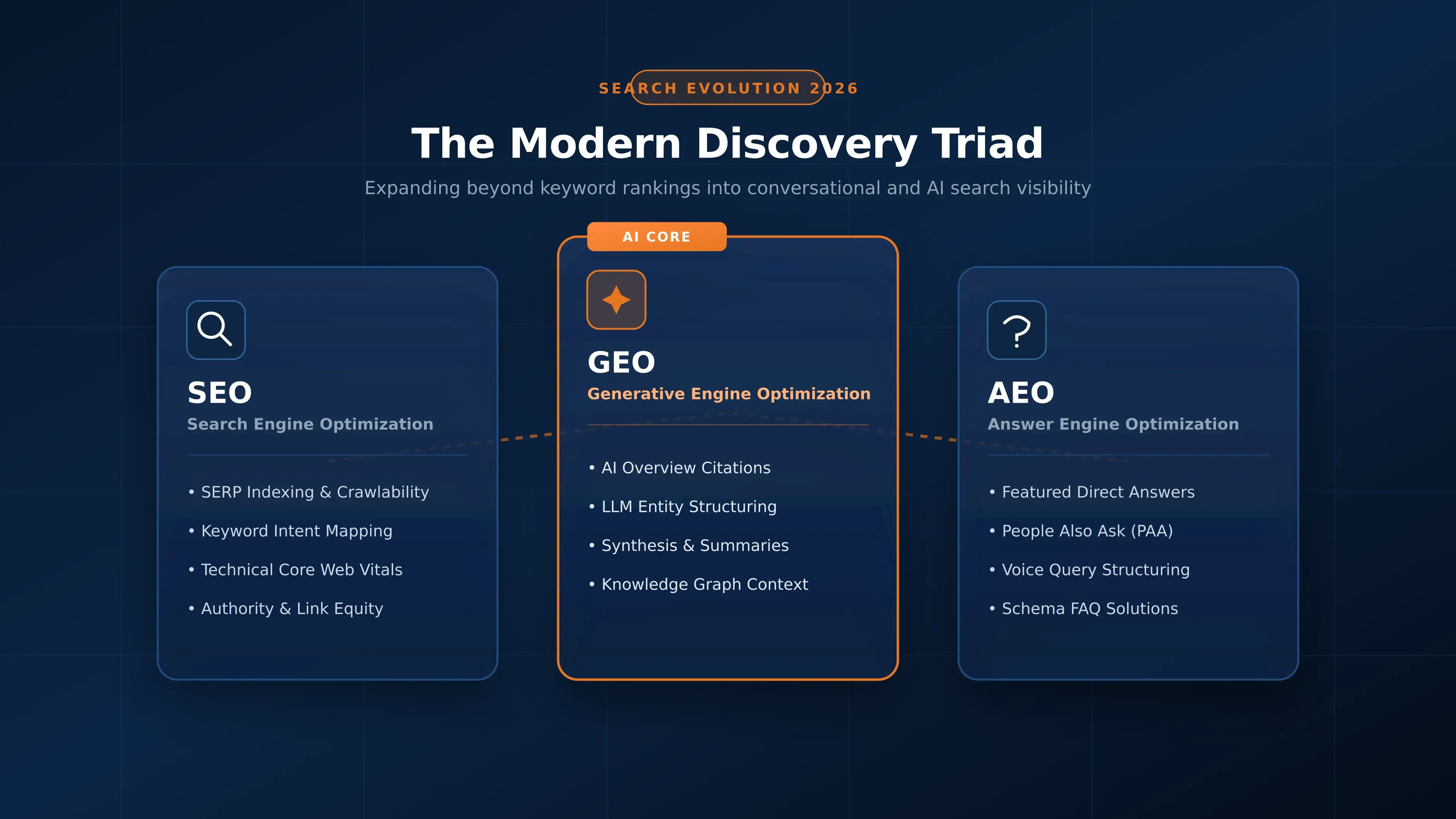
Search Engine Optimization
SEO focuses on improving a website's visibility in traditional search results. It includes activities such as keyword research, on page optimization, technical improvements, internal linking, and link building.
Generative Engine Optimization
GEO focuses on making information more useful and discoverable in AI generated search experiences. Content should provide clear information, relevant context, and reliable answers that AI systems can understand and use.
Answer Engine Optimization
AEO focuses on answering specific questions clearly. This is especially useful when users search through conversational interfaces or expect direct answers.
A modern SEO professional may need to work across all three areas rather than treating them as completely separate disciplines.
How AI Is Changing SEO Research and Content Creation
AI is changing the way marketers approach SEO research and content development. Tools can help identify topics, group search queries, analyse competitors, generate content ideas, and identify gaps.
However, AI should support the marketer rather than replace human judgment.
For example, ai for seo can help a marketer:
- Generate initial topic ideas
- Group related keywords by search intent
- Identify content gaps
- Create content briefs
- Analyse large amounts of search data
- Suggest questions users may ask
- Improve content structure
- Identify opportunities for internal linking
The marketer still needs to check facts, understand the audience, review the content, and make strategic decisions. This is why modern SEO training needs to include both SEO fundamentals and practical AI skills.
Building a Website That Converts Search Traffic into Leads
Getting visitors to a website is only one part of digital marketing. A business also needs to turn relevant visitors into leads or customers.
A marketing website should therefore be designed around both search visibility and user experience.
Important Elements of a Conversion Focused Website
A website should make it easy for visitors to understand what the business offers and what they should do next.
Key elements include:
- Clear page structure
- Simple navigation
- Useful and relevant content
- Strong calls to action
- Fast loading pages
- Mobile friendly design
- Trust signals and testimonials
- Simple lead forms
- Relevant landing pages
For example, someone searching for a digital marketing course should quickly understand the course benefits, duration, curriculum, learning format, and next step. This shows why SEO increasingly connects with conversion rate optimization and broader marketing strategy.
How Technical SEO Supports Search Visibility
Technical SEO helps search engines access, understand, and index a website properly. Even high-quality content can struggle to perform if the website has technical problems.
A modern SEO professional should understand areas such as:
- Website speed
- Mobile usability
- Crawlability
- Indexing
- XML sitemaps
- Robots.txt
- Canonical tags
- Structured data
- Internal linking
- Website architecture
- Core Web Vitals
Technical SEO does not necessarily mean becoming a software developer. However, marketers should understand common technical issues and know how they can affect search visibility.
Why Local SEO Still Matters for Business Growth
AI and changing search behaviour have not removed the importance of local search. People still search for businesses, services, restaurants, clinics, educational institutes, and other services near them.
A properly maintained google business profile can help a local business provide important information such as its location, contact details, services, reviews, and operating hours.
Important Local SEO Activities
Businesses can improve local visibility by focusing on:
- Accurate business information
- Google Business Profile optimisation
- Customer reviews
- Local keywords
- Location based landing pages
- Local citations
- Relevant local content
For a local business, appearing in relevant local searches can be closely connected to actual enquiries and visits.
From Search Visibility to Lead Generation: Where Growth Marketing Begins
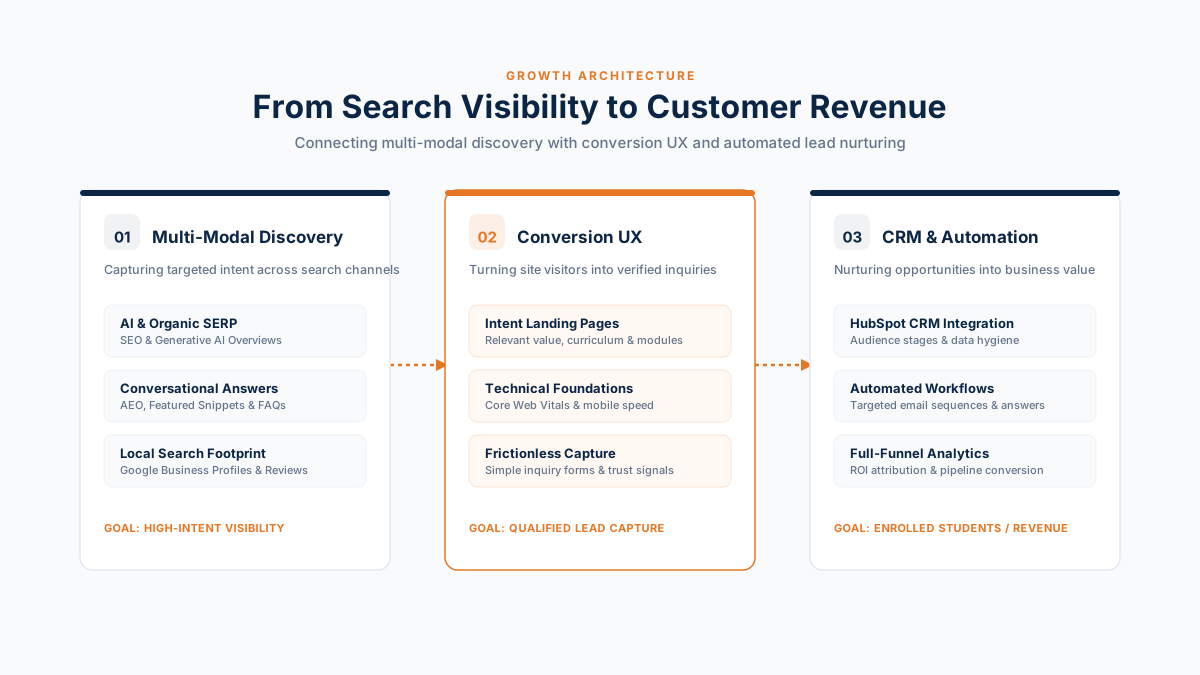
SEO should not operate separately from the rest of marketing. Once visitors reach a website, businesses need systems that help move those visitors through the customer journey.
This is where growth marketing becomes important.
A growth focused marketer may look at:
- Where website traffic comes from
- Which pages attract visitors
- Which pages generate leads
- Where users leave the website
- Which campaigns generate enquiries
- How leads move through the sales process
- Which channels generate business results
This approach moves the focus from traffic numbers alone to measurable business outcomes.
How CRM and Email Automation Turn Leads into Customers
Not every website visitor becomes a customer immediately. Some people need more information before making a decision.
A crm system can help businesses organise and manage leads after they submit a form, request information, or interact with the business.
Email automation can then support lead nurturing.
For example, a business may create an automated sequence that:
- Sends a welcome email.
- Provides useful information.
- Shares relevant resources.
- Answers common questions.
- Introduces the product or service.
- Encourages the lead to take the next step.
This connects SEO with content marketing, CRM, email marketing, and sales.
A strong content strategy therefore needs to consider the entire customer journey, not only search rankings.
Case Study: Moving from Basic SEO to Growth Marketing
Consider a training institute that initially focuses only on ranking for keywords related to digital marketing courses.
The institute publishes blogs, optimises pages, and builds backlinks. However, traffic does not consistently turn into enquiries.
A broader SEO and growth approach could include:
- Understanding search intent behind course related queries
- Creating detailed course pages
- Optimising content for traditional and AI search
- Improving technical SEO
- Optimising local search presence
- Adding clear enquiry forms
- Connecting forms with a CRM
- Creating automated email follow ups
- Tracking leads from different marketing channels
- Measuring enquiries and conversions
The institute is no longer treating SEO as only a ranking activity. It is connecting search visibility with the complete marketing funnel.
What Skills Does a Modern SEO and Growth Marketer Need in 2026?
The skills required for SEO are becoming broader. Someone entering this field should build a combination of marketing, technical, analytical, and AI skills.
A: Important skills include:
- SEO fundamentals
- Keyword and search intent research
- AI assisted SEO
- GEO and AEO
- Content planning
- Technical SEO
- Local SEO
- Website optimisation
- Analytics and reporting
- Conversion optimisation
- CRM management
- Email automation
- Paid advertising basics
- Social media marketing
- AI tools for marketing
This is one reason learners looking at courses on search engine optimization should check whether the curriculum covers modern search and growth marketing, rather than only traditional SEO concepts.
How to Build an SEO and Growth Marketing Career
A career in SEO can begin with the fundamentals, but professionals need to keep learning as search technology changes.
Instead of learning isolated tools, learners should understand how different activities work together.
A practical learning path can include:
Step 1: Learn SEO fundamentals
Understand keywords, search intent, on page SEO, technical SEO, backlinks, and analytics.
Step 2: Learn AI powered search
Understand GEO, AEO, AI assisted research, and how search behaviour is changing.
Step 3: Develop content skills
Learn how to create useful content based on audience needs and search intent.
Step 4: Learn website and conversion basics
Understand how website structure, landing pages, calls to action, and user experience influence results.
Step 5: Learn analytics and CRM
Learn how to measure traffic, leads, conversions, and customer journeys.
Step 6: Build practical projects
Work on real or simulated websites, campaigns, content plans, SEO audits, and reporting dashboards.
This combination can help learners move beyond basic SEO execution and understand the wider role of a growth marketer.
Why is SEO & Growth Marketing Specialist Applied Program by NIIT a Wise Choice
The SEO & Growth Marketing Specialist Applied Program by NIIT is designed to help learners develop practical skills in SEO, digital marketing, AI-assisted marketing, CRM, email marketing, and marketing automation. The program goes beyond traditional SEO by introducing emerging areas such as Generative Engine Optimization (GEO) and Answer Engine Optimization (AEO).
Learners work on practical business scenarios and build a portfolio-ready project that brings together website development, search optimization, lead generation, CRM, and marketing automation.
Program at a Glance
| Feature | Details |
|---|---|
| Program Name | SEO & Growth Marketing Specialist Applied Program |
| Provider | NIIT |
| Duration | 60 hours |
| Learning Approach | Sprint-based, hands-on learning |
| Key Areas | Digital marketing, SEO, GEO, AEO, CRM, email marketing, automation |
| Website Development | No-code WordPress development |
| AI Integration | AI-assisted research, content creation, audits and marketing workflows |
| Project Work | Digital makeover of an Indian small business |
| Certification | NIIT Professional Certificate |
| Program Fee | ₹20,999 |
What Does the Program Cover?
The curriculum combines foundational digital marketing knowledge with practical search, CRM and automation skills.
| Module | Key Topics Covered |
|---|---|
| Digital Marketing Foundations | Funnel strategy, campaign planning, ROI goals, competitor and market research, audience personas, buyer journeys, inbound marketing |
| AI for Marketing | AI-assisted research and marketing activities using ChatGPT, Gemini and Claude |
| No-Code Website Development | WordPress website creation, conversion-focused UX and AI-assisted content writing |
| SEO | Keyword research, on-page SEO, technical SEO, Core Web Vitals, site speed, off-page SEO, backlinks and Local SEO |
| Generative Engine Optimization (GEO) | Entity-based content, schema-ready content, ChatGPT and Gemini optimization, AI Overviews and structured data |
| Answer Engine Optimization (AEO) | Featured Snippets, People Also Ask, voice search, zero-click optimization and FAQ content |
| CRM for Digital Marketing | HubSpot setup, customer data import, audience segmentation, lifecycle stages and MarTech |
| Email Marketing & Automation | AI-personalized email campaigns, lead forms, landing pages, deliverability and automated workflows |
SEO, GEO and AEO: A Broader Search Strategy
One of the distinctive aspects of the program is its focus on search beyond conventional Google rankings.
| Search Area | What Learners Explore |
|---|---|
| SEO | Keyword research, on-page, technical, off-page and local optimization |
| GEO | Content optimization for AI-driven search experiences, entities and structured data |
| AEO | Answer-focused content, Featured Snippets, People Also Ask, voice search and FAQs |
| Local SEO | Google Business Profile optimization and local search visibility |
| Technical SEO | Site speed, Core Web Vitals and website audits |
This combination reflects how search experiences are expanding across traditional search engines, AI platforms and answer-focused interfaces.
AI Tools and Marketing Technologies
Learners receive hands-on exposure to tools used across different stages of the marketing workflow.
| Category | Tools |
|---|---|
| Generative AI | ChatGPT, Claude, Gemini |
| Website Development | WordPress |
| SEO & Search | Google Search Console, Screaming Frog, Ubersuggest |
| CRM | HubSpot |
| Automation | Make, n8n |
| Productivity & Data | Google Sheets, MS Excel |
These tools support activities such as market research, content development, website auditing, SEO analysis, CRM management, customer segmentation and marketing automation.
Practical Projects and Case Studies
The program places emphasis on applying concepts to realistic business situations.
| Project / Case Study | What Learners Explore |
|---|---|
| Digital Makeover for an Indian Small Business | Build a WordPress website, conduct keyword research, implement SEO, GEO and AEO, integrate HubSpot CRM and create a lead-generation system |
| Suzuki: CRM and Inbound Marketing | CRM, buyer personas, lead nurturing and data-driven inbound marketing |
| Casio: Email Marketing and CRM | Audience segmentation, automated email campaigns, CRM and measurable customer engagement |
The main project allows learners to work through the complete digital marketing journey, from building a website and attracting visitors to capturing, managing and nurturing leads.
Learning Outcomes
By the end of the program, learners can develop skills across several areas of modern digital marketing.
| Skill Area | Learning Outcome |
|---|---|
| Website Development | Build and launch a no-code website designed to attract visitors and generate leads |
| SEO | Apply keyword research, on-page, technical, off-page and local SEO techniques |
| GEO & AEO | Optimize content for AI-driven search and answer engines |
| Market Research | Conduct AI-powered market and competitor research |
| Audience Strategy | Develop personas and map customer journeys |
| Technical Audits | Identify website performance and technical issues using diagnostic tools |
| Local Search | Optimize Google Business Profiles and improve local visibility |
| CRM | Configure CRM systems, organize customer information and segment audiences |
| Email Marketing | Create personalized email campaigns and automated workflows |
| Generative AI Content | Create and refine website, blog and email content using AI |
| Marketing Automation | Connect different marketing activities through automation workflows |
| Portfolio Development | Build and present a practical project combining multiple marketing functions |
Learning Methodology
The program uses a combination of structured learning, mentor interaction and practical application.
| Learning Component | How It Supports Learners |
|---|---|
| Structured Learning Roadmap | Provides defined milestones and module progression through the LMS |
| Learner Connect Sessions | Enables learners to interact with mentors and clarify doubts |
| Hands-on Learning | Allows learners to apply concepts through projects and business scenarios |
| AI-Assisted Faculty Monitoring | Supports consistency in teaching quality and delivery |
| Performance Tracking | Tracks attendance, assignments, assessments, quizzes and overall progress |
| Case Studies | Helps learners connect marketing concepts with real business situations |
Certification
Successful learners receive an NIIT Professional Certificate for the SEO and Growth Marketing Specialist Applied Program.
| Certification Benefit | Details |
|---|---|
| Professional Recognition | Demonstrates completion of the applied program |
| Certificate can be added to a professional profile | |
| Resume | Can be included as part of professional qualifications |
| Portfolio | Can accompany the learner's practical project work |
| Skill Demonstration | Documents learning across SEO and growth marketing |
Duration, Batches and Fee
| Particular | Details |
|---|---|
| Total Duration | 60 hours |
| Batch 1 | 30 September, Monday, Wednesday and Friday |
| Batch 1 Timing | 7:30 PM to 9:30 PM |
| Batch 2 | 6 October, Monday, Wednesday and Friday |
| Batch 2 Timing | 9:00 AM to 11:00 AM |
| Custom Schedule | Preferred slot assistance available |
| Program Fee | ₹20,999 |
Who Can Consider This Program?
The program can be relevant for learners and professionals interested in developing skills in SEO, digital marketing, growth marketing, CRM, email marketing, marketing automation and AI-assisted marketing.
It may also be useful for those who want to understand how search is evolving from conventional SEO toward GEO, AEO and AI-driven search experiences.
| Suitable Learning Goal | Relevant Program Areas |
|---|---|
| Learn SEO | SEO, technical SEO, local SEO, keyword research |
| Learn AI-assisted marketing | ChatGPT, Gemini, Claude and AI workflows |
| Build websites | WordPress and no-code website development |
| Learn growth marketing | Lead generation, funnels and conversion-focused marketing |
| Learn CRM | HubSpot, segmentation and customer lifecycle management |
| Learn email marketing | Campaigns, personalization and automation |
| Understand emerging search | GEO and AEO |
| Build a portfolio | Digital makeover project and case studies |
Why This Program Can Be Included in a Digital Marketing Career Article
The program can be naturally introduced in a blog about modern SEO, digital marketing careers, AI in marketing, or growth marketing because it connects several skills that are increasingly used together.
Instead of learning SEO, website development, CRM and email marketing as completely separate areas, learners work toward a complete workflow:
| Stage | Skills Applied |
|---|---|
| 1. Build | WordPress website development |
| 2. Discover | Keyword, market and competitor research |
| 3. Optimize | SEO, technical SEO, GEO and AEO |
| 4. Attract | Organic search and local visibility |
| 5. Capture | Forms, landing pages and lead generation |
| 6. Manage | CRM and audience segmentation |
| 7. Nurture | Personalized email campaigns |
| 8. Automate | Marketing workflows using automation tools |
| 9. Demonstrate | Portfolio-ready project |
This makes the program particularly suitable for a blog section discussing how modern digital marketers need to combine search, AI, content, CRM and automation rather than rely on a single marketing skill.
Build Your Skills With NIIT
The SEO profession in 2026 is no longer limited to keywords and rankings. AI powered search, GEO, AEO, technical SEO, local SEO, content, analytics, CRM, and conversion optimisation are becoming part of the modern digital marketing skill set.
For learners who want to build these skills together, NIIT Digital provides career focused learning opportunities that combine digital marketing concepts with practical tools and emerging technologies. Learning ai seo as part of a broader SEO and growth marketing approach can help learners prepare for the changing digital marketing landscape.
Want to build modern SEO and growth marketing skills?
Explore NIIT Digital's career focused programs and learn how SEO, AI, content, analytics, CRM, and digital marketing work together to support business growth.
Explore the ProgramFrequently Asked Questions
1. Is a basic SEO course enough in 2026?
A: A basic SEO course can provide a useful foundation, but modern SEO increasingly involves AI powered search, GEO, AEO, technical SEO, local SEO, analytics, conversion optimisation, and broader growth marketing skills.
2. What is AI SEO?
A: AI SEO refers to using AI technologies and approaches to support SEO activities such as research, content planning, search intent analysis, optimisation, and understanding AI driven search experiences.
3. Should SEO professionals learn AI tools?
A: Yes. AI tools can support research, content planning, data analysis, and several other SEO activities. However, professionals still need human judgment, strategic thinking, fact checking, and audience understanding.
4. What skills are important for an SEO career?
Important skills include SEO fundamentals, keyword research, technical SEO, content strategy, analytics, local SEO, AI assisted SEO, GEO, AEO, conversion optimisation, CRM, and digital marketing.
5. Can SEO lead to a digital marketing career?
A: Yes. SEO can be a strong foundation for a broader digital marketing career. Professionals can expand into content marketing, paid advertising, social media, analytics, CRM, email marketing, conversion optimisation, and growth marketing.
NIIT
Expert Contributor
Industry expert contributing to NIIT's knowledge base on technology and education.