


AI Full-Stack Development Professional Program
Master AI-powered full-stack development with Java, React, Spring Boot, distributed systems, and cloud deployment through hands-on projects.
Program Overview
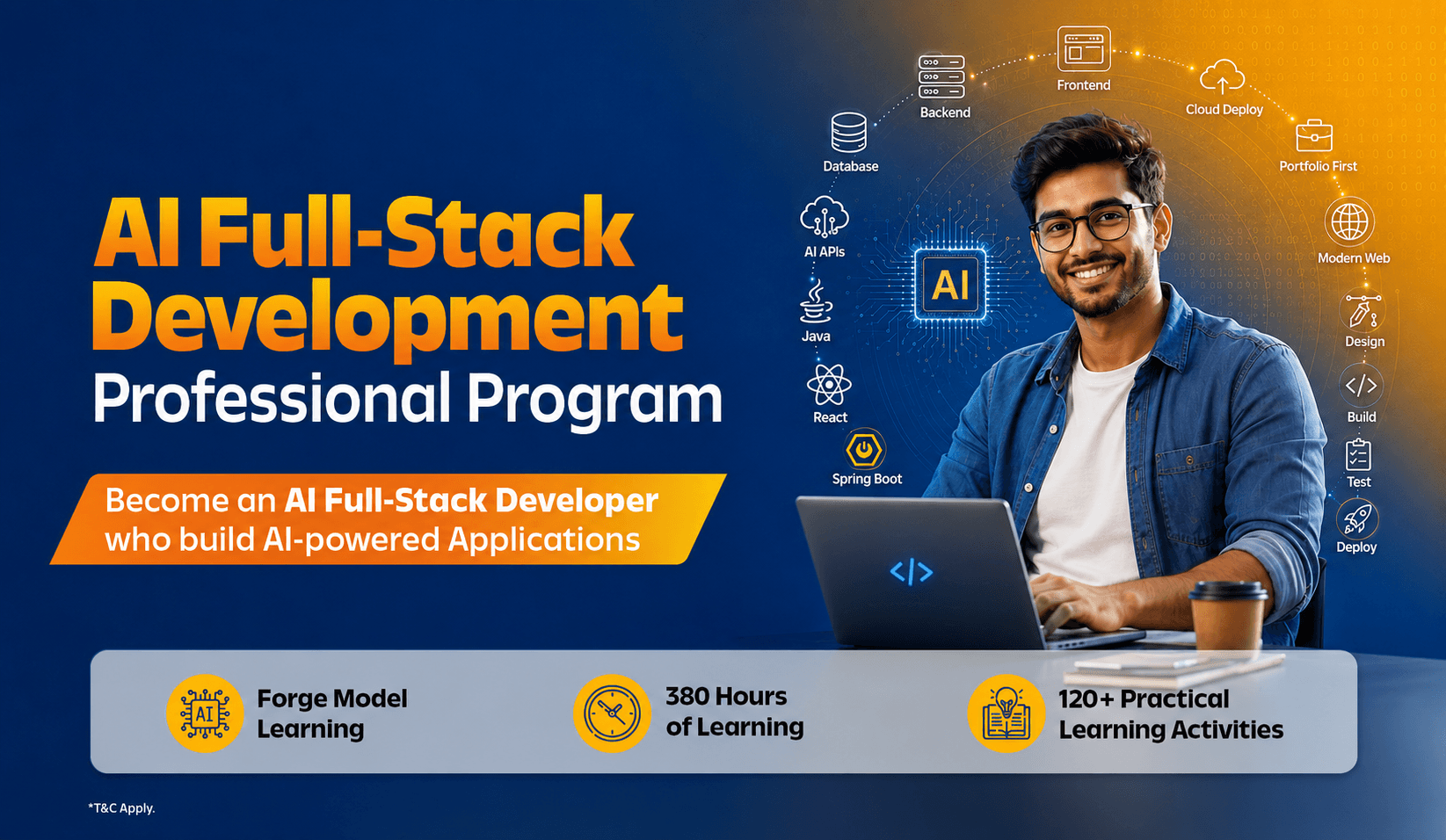
The AI Full-Stack Development Professional Program from NIIT equips learners with production-ready full-stack software development skills by combining Java, React, Spring Boot, distributed systems, cloud deployment, and AI-assisted development practices. Through live mentor-led sessions, hands-on labs, coding exercises, real-world projects, and a capstone, learners gain practical experience in designing, building, testing, deploying, and maintaining scalable full-stack applications. The program emphasizes software engineering best practices, modern development frameworks, cloud-native workflows, and portfolio development to prepare learners for in-demand full-stack developer roles.
Curriculum
Comprehensive curriculum to build in-demand tech skills and real-world expertise.
Development Environment
Set up a complete Java development environment by configuring IDEs, JDK, VS Code, Node.js, and PostgreSQL to create, debug, test, and manage software projects efficiently and confidently.
Version Control
Learn Git and GitLab fundamentals, configure SSH keys, and create README.md files using Markdown to manage source code, collaborate effectively, and maintain complete version history.
Java Programming
Learn Java fundamentals including datatypes, variables, operators, decision making, loops, arrays, functions, searching, sorting, strings, and StringBuilder to build quality programs.
Object-Oriented Programming
Master object-oriented programming using classes, objects, encapsulation, inheritance, polymorphism, abstraction, interfaces, packages, and exception handling for robust software design.
Demonstrate your learning through a comprehensive course-end assessment, validating programming knowledge, coding proficiency, problem-solving ability, and overall technical readiness.
Data Structures & Algorithms
Master data structures and algorithms including Big O, binary search, hashing, linked lists, stacks, queues, recursion, and sorting techniques to solve coding challenges efficiently.
SQL & Databases
Learn PostgreSQL, ER modeling, normalization, SQL queries, joins, aggregations, subqueries, DML, DDL, and JDBC connectivity to build, manage, and query enterprise databases effectively.
Agile Workflows
Understand Agile software development through Scrum roles, sprint planning, epics, user stories, backlog management, and JIRA workflows to collaborate effectively in engineering teams.
SCVHS Setup
Configure the SCVHS engineering pipeline using GitHub Copilot, AI Decision Logs, and specification-driven development.
Apply your learning by completing a comprehensive course-end project and presenting your solution through a structured technical demonstration that showcases engineering, coding, problem-solving, and communication skills.
Modern Java
Learn modern Java using records, sealed classes, collections, streams, lambda expressions, concurrency, SCVHS practices, and functional programming to build robust applications efficiently.
Design Principles
Apply SOLID design principles including SRP, OCP, LSP, ISP, and dependency management to build scalable, maintainable, extensible, and high-quality enterprise software applications.
Design Patterns
Implement behavioral and structural design patterns including Strategy, Builder, Observer, Adapter, Facade, Decorator, Proxy, and Template Method for reusable software solutions.
Testing
Develop reliable software using JUnit 5, parameterized testing, assertions, JaCoCo code coverage, and testing best practices to ensure application quality and maintainability always.
Apply your learning by completing a comprehensive course-end project and presenting your solution through a structured technical demonstration that showcases engineering, coding, problem-solving, and communication skills.
Environment
Set up a modern web development environment using VS Code, Live Server, Git, GitLab, GitHub Copilot, Chrome, and W3C validation tools to build, test, and manage web applications efficiently.
HTML & CSS
Build responsive websites using semantic HTML5, CSS selectors, Flexbox, Grid, Tailwind CSS, typography, Figma, and W3C validation following modern web design best practices throughout.
JavaScript
Learn JavaScript fundamentals including variables, datatypes, conditions, loops, arrays, functions, arrow functions, and array methods to create dynamic and interactive web applications.
Web Interaction
Create interactive web experiences using the DOM, event handling, HTTP methods, Promises, Axios, async/await, and API integration to build responsive and dynamic applications smoothly.
Demonstrate your learning through a comprehensive course-end assessment, validating programming knowledge, coding proficiency, problem-solving ability, and overall technical readiness.
React Foundations
Learn React using JSX, Node.js, npm, Vite, and functional components. Apply TypeScript, interfaces, typed props, and events. Build responsive single-page applications using React.
Component Architecture
Build reusable React components using props, composition, state, hooks, controlled forms, event handling, dependency arrays, and custom hooks for scalable application development.
Navigation & State
Implement application navigation using React Router, protected routes, dynamic routing, Context API, and useReducer for scalable state management without unnecessary prop drilling.
Testing & Server State
Test React applications using Jest, React Testing Library, TanStack Query, caching, mutations, mocked APIs, and server-state management to deliver reliable user experiences.
Apply your learning by completing a comprehensive course-end project and presenting your solution through a structured technical demonstration that showcases engineering, coding, problem-solving, and communication skills.
Spring Boot Fundamentals
Learn Spring Boot fundamentals including IoC, dependency injection, REST APIs, layered architecture, bean scopes, Spring starters, Postman, and enterprise application development.
Data Persistence
Master data persistence using JPA, Hibernate, entity mapping, relationships, transactions, pagination, sorting, filtering, Flyway migrations, and efficient database access patterns.
Security & Exception Handling
Secure Spring Boot applications using Spring Security, JWT, OAuth, CORS, AOP, custom exceptions, global exception handling, and role-based access control for enterprise applications.
DevOps & Testing
Build, test, and deploy Spring Boot applications using Docker, Docker Compose, Testcontainers, JaCoCo, OpenAPI, Swagger UI, Actuator, and integration testing best practices.
Apply your learning by completing a comprehensive course-end project and presenting your solution through a structured technical demonstration that showcases engineering, coding, problem-solving, and communication skills.
Architecture & System Design
Learn software architecture using monoliths, microservices, scalability, CAP theorem, API gateways, resilience patterns, domain-driven design, and Spring Modulith for enterprise systems.
Microservice Communication
Build distributed applications using synchronous and asynchronous communication, REST clients, service discovery, RabbitMQ, Spring AMQP, and event-driven architecture patterns.
Databases & Caching
Implement scalable data solutions using MongoDB, Redis, Spring Cache, distributed caching, database-per-service, idempotency, transactions, and high-performance data access patterns.
DevOps & Observability
Configure production-ready applications using Spring Profiles, structured logging, tracing, Docker or Rancher Desktop: containerization and Docker Compose, Kubernetes Foundations
Demonstrate your learning through a comprehensive course-end assessment, validating programming knowledge, coding proficiency, problem-solving ability, and overall technical readiness.
Capstone Build
Design and build a production-ready AI application by defining architecture, APIs, data models, messaging, caching, authentication, and frontend integration through a guided capstone project.
Testing, Observability & Reliability
Ensure application quality using unit and integration testing across backend and frontend systems, while implementing logging, monitoring, error handling, resilience patterns, and performance optimization for reliable deployments.
Deployment & Portfolio
Deploy applications using modern DevOps practices including Docker and CI/CD pipelines, and showcase your work through live applications, GitHub portfolios, technical documentation, and structured project walkthroughs.
Advanced DSA for Interviews
Strengthen problem-solving skills through structured practice of trees, graph traversal algorithms, greedy strategies, and dynamic programming for technical interview readiness.
Project Presentation & Stakeholder Evaluation
Present and demonstrate the end-to-end project workflow, outcomes, and key learnings to stakeholders for assessment of functional completeness, integration depth, and design quality.
Design, build, test, and deploy a production-ready full-stack distributed system with embedded agentic AI, then present your solution through a live review before an expert panel.
Tools & Technologies
Explore industry-relevant tools through hands-on learning to master practical, in-demand skills.


Projects You'll Build
Build production-ready projects to showcase real-world skills and strengthen your portfolio.
Spec-Driven Java CLI Application Backed by PostgreSQL
Build a specification-driven Java CLI application integrated with PostgreSQL for CRUD operations. Apply JIRA sprint workflows, and CI pipelines while following the complete SCVHS development cycle to deliver a production-ready solution.
Java Application with Design Patterns and a JUnit Test Suite
Build a Java application using SOLID principles and 5+ GoF design patterns, supported by a comprehensive JUnit test suite with over 70% JaCoCo coverage. Document AI-assisted design decisions, code reviews, and implementation choices in an AI Decision Log.
React SPA in TypeScript with Live Vercel Deployment
Build a responsive single-page application using React, TypeScript, and Tailwind CSS. Implement efficient data fetching with TanStack Query, deploy your app on Vercel, and optimize performance to achieve a Lighthouse score above 80.
Containerized Full-Stack Application
Build and containerize a full-stack application with a Spring Boot REST API and database integration. Design contract-first APIs using OpenAPI, implement secure JWT authentication, optimize JPA to eliminate N+1 queries, and deploy seamlessly with Docker Compose.
Capstone – Building and Shipping a Full-Stack Distributed System
Design, build, test, and deploy a production-ready distributed system with embedded AI. Develop backend APIs, frontend applications, messaging, caching, and observability, then showcase your solution through a live capstone presentation.
Boost Your Career Visibility
Showcasing a professional Capstone Project on your LinkedIn increases recruiter interest significantly. Build production-ready work that speaks for itself.
Learning Outcomes
Develop industry-relevant skills to create real-world solutions and advance your career.
Solve DSA problems and write efficient SQL queries to build strong analytical and engineering problem-solving skills together.
Build and ship full-stack web applications using Java, Spring Boot, React, APIs, and modern web development practices.
Apply advanced Java concepts and design principles to develop clean, maintainable, scalable production-grade software.
Design and build distributed systems and microservices using modern architecture patterns for scalable enterprise systems.
Write engineering specifications and guide AI using the SCVHS Pipeline while validating and hardening every solution built.
Present engineering solutions through architecture walkthroughs, live demonstrations, and a professional technical portfolio.
Industry Salary Growth
Accelerate your career with strong salary growth across India.
Select Experience Level

Salary Growth
Annual PackagesCurrently Hiring Companies for this role



Industry-Recognized Certification
Certificate of Completion
This is to certify that
Has successfully completed the AI Full-Stack Development Professional Program
Signature
Date
Earn a trusted NIIT professional certificate.
Global Recognition
Accepted by leading employers and organizations worldwide.
Easy Sharing
Add your certificate to LinkedIn, resumes, and professional portfolios.
Career Value
Demonstrates practical skills aligned with industry needs.
Placement Assistance
Dedicated placement support with industry connections and recruiter interactions.
Placement Assistance Policy
Dedicated placement assistance with leading industry hiring partners. Refer to the FAQ and T&C sections for placement eligibility details.
Our Hiring Network
800+ Top Recruiting Companies




Data-Driven Learning, Delivered with Quality
Experience a data-driven learning ecosystem with measurable progress.
Structured Learning Roadmap
Clear learning pathways delivered through our LMS with defined milestones and module progression.
Learner Connect Sessions
Regular live mentor interactions to resolve doubts, reinforce concepts, and maintain engagement.
AI Assisted Faculty Quality Monitoring
AI-assisted faculty performance analysis ensures consistent teaching quality and delivery excellence.
Program Performance Report
Track attendance, assignments, assessments, quizzes, and overall performance with structured progress tracking.
Meet Your Mentors
Learn from Industry Experts and Experienced Professionals.
Rajeswara Reddy Munnam
Mentor
Rajeswara Reddy Munnam is an accomplished NIIT Mentor for the Full Stack Software Engineering Program and the IT SysAdmin & Cloud Computing Advanced Program, bringing over 18 years of experience in mentoring graduates, undergraduates, and working professionals. With deep expertise across enterprise technologies, cloud, cybersecurity, databases, and modern AI tools, he combines strong conceptual grounding with hands-on, project-based learning that mirrors real-world challenges. Backed by global certifications from Microsoft and Cisco and recognized with NIIT’s Inspiring Mentor Award and Award of Excellence, Rajeswara is widely respected for his engaging, learner-focused training style. Passionate about continuous learning, he empowers learners not just to be job-ready, but to build sustainable, future-ready technology careers

Sangeetha B
Mentor
Sangeetha B is a Seasoned Mentor at NIIT, with over 15 years of experience in Training, Content Development and Academic Leadership. With a strong technical foundation and a learner-first mindset, she has mentored thousands of students, guiding them to master technology skills and successfully transition into rewarding IT careers. A B. Tech graduate in Information Technology, Sangeetha’s technical expertise spans Java (Servlet, JSP, Struts, WCD), Python, C, C++, .NET (ASP.NET, C#.NET), PHP, Big Data (Hadoop, MapReduce, Ecosystem tools), Databases (SQL Server, MongoDB, Oracle, MySQL, SQLite, MS Access), and Web Development (HTML, CSS, JavaScript). Sangeetha is known among her students as a favorite mentor, appreciated for her ability to understand learners’ mindset. Many alumni attribute their success to her consistent guidance, practical insights, and motivating teaching style.

Rohit Kumar
Senior Mentor
Rohit Kumar is a Senior Mentor at NIIT with over 13 years of experience in Data Science, Machine Learning, Python, and Full Stack Development. He is known for making complex topics easy to understand and apply in real-world scenarios. His expertise spans across Full Stack Development, Data Analytics, Machine Learning, Big Data, Cloud Computing, Blockchain, and AI-driven applications and he holds multiple globally recognized certifications. He is also an Enterprise Design Thinking Practitioner and a published researcher in image encryption and security algorithms, reflecting his strong analytical and problem-solving skills. Through hands-on projects, real-world datasets, and continuous guidance, he helps learners build confidence and become job-ready technology professionals.

Dr. Ayan Chatterjee
Chief Technology Officer
Dr. Ayan Chatterjee is the Chief Technology Officer at InsAnalytics, bringing over 8 years of research and development experience across Artificial Intelligence, Machine Learning, Mathematical Modeling, Medical Image Processing, and AI-driven Drug Discovery. A Gold Medalist in B.E, and a PhD in Computer Science from Northeastern University, Boston he combines academic excellence with global research credentials. His professional contributions include GPU architecture design at NVIDIA, with deployments in autonomous vehicle systems at Tesla. He has also led the end-to-end development of AI-powered medical imaging solutions for brain tumor diagnostics using MRI scans and built scalable AI platforms supporting drug discovery and gene therapy initiatives at AstraZeneca. With a strong foundation in both research and applied AI, Dr. Chatterjee brings deep technical insight and industry relevance to train the learners of Building Agentic AI Systems at NIIT.

Amrita Saha
Senior Data Scientist
Ms. Amrita Saha is a seasoned Senior Data Scientist with over 15 years of combined industry and R&D experience across AI/GenAI, Machine Learning, Big Data Analytics, and advanced Statistical and Econometrics Modeling. Her expertise spans diverse domains with hands-on proficiency in Robotics Process Automation (RPA), core economic research, and Business Intelligence with a strong focus on data visualization and dashboarding. She holds an M.Sc. in Economics, an M. Tech in Data Science & Engineering, and is a PhD Scholar in AI & Energy Economics at the Department of Finance & Economics, BITS Pilani. She plays a pivotal role in guiding learners in NIIT’s Building Agentic AI Systems program, enabling them to develop practical, industry-ready expertise in next-generation AI systems.
Success Stories
Hear from our graduates about their transformative journey with NIIT.

Abhishek Gupta
"A mentor is someone who sees more talent and ability within you than you see in yourself—and helps bring it out. That’s exactly what I experienced at NIIT. From day one, the focus was on building strong fundamentals and understanding how to develop a product from scratch. Being mentored by such dedicated faculty was a blessing. Each of them played a key role in shaping not just my technical skills but also my mindset. By the end of the journey, I had the confidence to build real products and take ownership of my work. It was a transformative experience."

Anirban Dutta
"NIIT provided exceptional support throughout the course. The curriculum was challenging yet well-structured, and the mentors were always available to guide us. The course materials were comprehensive and helped in grasping key concepts effectively. The mentoring approach was engaging, and collaborating with learners from diverse backgrounds was a refreshing experience. The mentors communicated clearly and created a supportive learning environment. Overall, it’s a solid program—I learned a lot. Special thanks to all the mentors and the placement team for helping me secure a great opportunity."

Pooja Solanki
"I have completed B.Tech. in the electrical stream, that's why I was bit worried to join this course. But my confidence was increased gradually in coding day by day after joining NIIT. All teachers and mentors are very helpful. And when I worked on a project, it boosted my confidence a lot. Finally, my purpose of joining this course was also completed when I got a job in a reputable company. I want to thank all mentors and NIIT for evolving me as a full-stack developer."
Frequently Asked Questions
Find answers to your queries about the program, curriculum, and admissions.
Candidates with a minimum of 50% in Class X, XII, and graduation are eligible to apply. Undergraduates must maintain at least 50% marks until the final year and achieve a minimum 50% aggregate upon graduation.
The program is open to MCA, M.Sc IT, BE/B.Tech, BCA, B.Sc (Physics, Chemistry, Maths, Statistics, CS, IT), and B.Com (IT, CS, Maths, Statistics) graduates.
No prior programming experience is required. The program starts with Java fundamentals, guiding learners step by step from setting up their development environment to building production-ready applications. Whether you're a beginner or a working professional, the curriculum is designed to help you build strong, industry-ready Java development skills.
Admission to the program is direct. Eligible learners can apply by filling out the online application form, submitting the self-declaration and accepting the terms and conditions, and paying the program fee. Admission is confirmed once the payment is successfully completed.
The complete program spans 95 sprints (380 hours) and can be completed in approximately 6 months. Each sprint includes 2 hours of instructor-led learning and 2 hours of self-guided hands-on practice.
The program follows NIIT’s Mastery Learning methodology, focusing on building one skill at a time through structured, hands-on sprints. Each sprint includes concept introduction through live mentor sessions, individual practice and assignments, mentor review and feedback, and refinement with re-submission of work.
The program follows a blended learning model, combining live instructor-led sessions with self-guided hands-on practice.
Each sprint includes 2 hours of live learning and 2 hours of practical application to help learners build skills through both guidance and execution.
The AI Full-Stack Development Professional Program is a comprehensive, industry-aligned program that prepares learners for entry-level full-stack development roles. Across 95 sprints (380 hours), learners build a strong foundation in front-end development, back-end development, databases, cloud deployment, DevOps, AI-assisted software engineering, and professional practices. The program culminates in an industry-style Full-Stack Engineering (FSE) Capstone project, after which learners earn the AI Full-Stack Development Professional Program certificate and are ready to begin their careers as full-stack developers.
DSA in this program provides a focused foundation in core data structures, algorithms, and problem-solving techniques, helping learners develop strong logical thinking and coding proficiency for software engineering roles. SQL and database querying are covered separately and in greater depth as part of the full-stack development curriculum, recognizing that application development and data management require distinct but complementary skill sets.
The AI Full-Stack Development Professional Program prepares learners for entry-level software engineering roles such as Full-Stack Developer, Front-End Developer, Back-End Developer, Web Application Developer, Associate Software Engineer, and Software Developer. The curriculum emphasizes hands-on development, cloud deployment, DevOps, AI-assisted software engineering, and an industry-style capstone project, equipping learners with the practical knowledge and technical skills required to contribute effectively to modern software development teams.
Graduates of the program are prepared to pursue a variety of entry-level software development roles, including Associate Software Engineer, Full-Stack Developer, Front-End Developer, Back-End Developer, Java Full-Stack Developer, Web Application Developer, and Software Developer.
The curriculum places a strong emphasis on hands-on learning and real-world project experience, enabling learners to build, test, deploy, and maintain modern applications using industry-standard tools and practices. Key focus areas include cloud deployment, DevOps methodologies, agile development practices, and AI-assisted software engineering, ensuring that learners gain practical experience across the complete software development lifecycle.
Through project-based learning, guided labs, and an industry-style capstone project, participants develop the technical proficiency, problem-solving capabilities, and collaborative skills required to contribute effectively in professional development teams and succeed in today’s rapidly evolving technology landscape.
Taking a loan is entirely optional. Loans are facilitated by third-party lenders, and NIIT has no role in the process. Applicants must review the loan terms carefully, including EMIs, interest rates, processing fees, and repayment schedules. All EMI payments and related queries must be handled directly with the lender.
Documents may include PAN Card and Aadhaar Card, last 6 months’ bank statements, 3 months’ salary slips (for employed learners) or ITR proof (for self-employed), and co-applicant details if the learner is under 21 years of age. Incomplete documentation may result in loan rejection.
A modern laptop or desktop with a stable internet connection is sufficient for the AI Full-Stack Development Professional Program. The minimum recommended configuration includes an Intel Core i3 (8th Gen+) or AMD Ryzen 5 processor, 8 GB RAM, 256 GB SSD with at least 50 GB free storage, and Windows 10, macOS 11, or Ubuntu 20.04 (or later). A dedicated GPU is not required, as the program focuses on web application development, cloud platforms, and AI-assisted software engineering. Learners should also have access to a 10 Mbps or higher broadband connection, along with a webcam and microphone for live sessions, assessments, mentoring, and mock interviews.
All software required for the AI Full-Stack Development Professional Program is free to use or available through free tiers. Learners work with industry-standard tools including OpenJDK 21 LTS, IntelliJ IDEA Community Edition, Visual Studio Code, Node.js, React, Git, GitHub Copilot, Docker Desktop/Rancher Desktop, PostgreSQL, and Postman/Thunder Client. This modern software stack provides hands-on experience in full-stack application development, API design and testing, database management, containerization, version control, and AI-assisted software engineering, enabling learners to build and deploy production-ready web applications throughout the program.
Throughout the AI Full-Stack Development Professional Program, learners will use industry-standard cloud and AI platforms, including AWS, Vercel, and GitHub Copilot, to support application development, deployment, and AI-assisted software engineering. Learners will leverage free-tier services where available for hosting, testing, and deployment activities, while gaining hands-on experience with modern cloud-based development workflows. NIIT will provide setup guidance, account creation support, and onboarding instructions for all required platforms.
Yes, learners receive a digital certificate after successfully completing the program and meeting all the required conditions (overall performance score, attendance, payment clearance etc).
Placement support is offered based on the learner’s profile and eligibility.
Learners eligible for Placement Assistance may receive up to a defined number of selection opportunities within 120 days of joining the Placement Bank, subject to criteria such as a minimum 70% overall score, graduation, age below 28 years, and stream eligibility as specified in the Program Eligibility table. Final-year undergraduate learners become eligible only after completing graduation, where applicable.
Placement support also includes three personalized coaching connects, end-to-end assistance during placement drives, and seven Placement Preparation Module sessions. These sessions cover interview preparation, aptitude development, digital profile building, corporate etiquette, personality development, industry talks, and alumni talks.
Learners aged 28 years or above are eligible for Career Support.
Career Support provides access to relevant lateral opportunities through the Alumni forum for up to 120 days, based on hiring demand and role fit. This support is designed to help experienced professionals explore suitable career opportunities aligned with their background and goals.
Final selection depends on the learner’s preparation, participation, and performance throughout the hiring process.
Hassle-Free Refund Policy
Your satisfaction is our priority. We offer transparent refund terms for your peace of mind.
100% Money-Back Guarantee
Full refund (excluding the booking fee) if you cancel before the batch starts
Quick Refund Review
Eligible refund requests are carefully reviewed within seven working days
Transparent Refund Timeline
Approved refunds are completed within 45 days for timely settlement
Important: Please review our full refund policy terms of service for detailed information.
Tell us your preferred slot
Custom Schedule Assistance
Investment Plan
Secure your future today
Exclusive of 18% GST
Secure your seat with a token booking fee of ₹1,500 today.
Exclusive of 18% GST