


Advanced Python Applied Program
Build practical Python and data analysis skills with AI-assisted coding, NumPy, Pandas, SQL, data visualization, statistics and exploratory data analysis through hands-on learning.
Program Overview
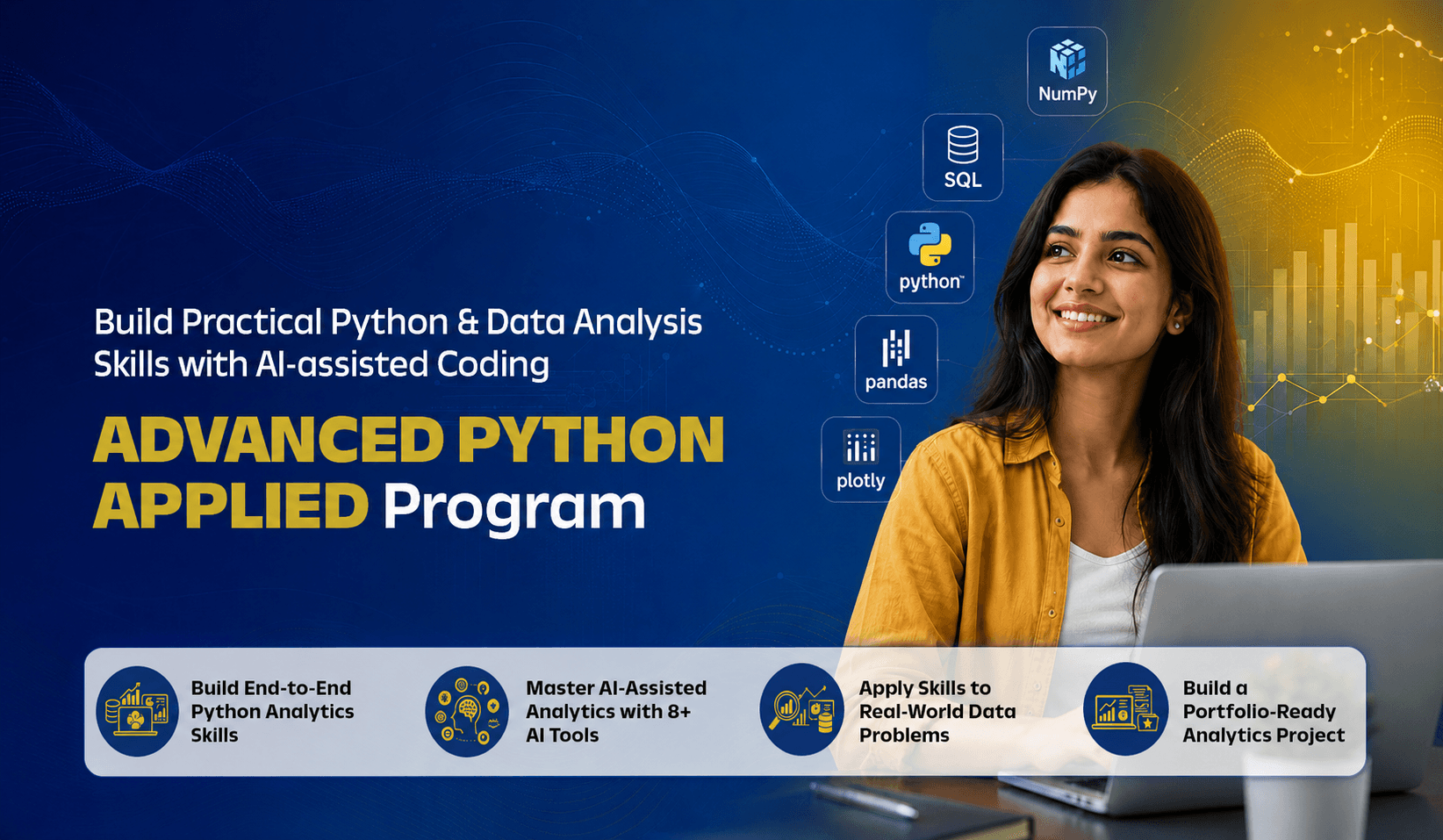
The Advanced Python Applied Program by NIIT develops AI-Augmented Python Practitioners through a structured, hands-on journey across the Python-for-analytics lifecycle: Code, Prepare, Visualize, Analyze, Explore and Present. Learners build practical skills in Python, OOP, NumPy, Pandas, SQL, data visualization, statistics and EDA. AI tools including GitHub Copilot, ChatGPT, Julius AI, Google Colab Gemini and Amazon Q Developer support coding, debugging and analysis, while YData Profiling, Sweetviz and AutoViz accelerate EDA. Learners also develop independent programming and analytical judgment, culminating in an EDA report, interactive Streamlit dashboard and business presentation.
Curriculum
Comprehensive curriculum to build in-demand tech skills and real-world expertise.
Python Programming Fundamentals
Understand Python syntax, variables, data types, and operators; write programs using input, output, expressions, and type conversions; develop logical problem-solving skills through programming exercises and practical coding tasks.
Decision Making & Iterative Programming
Implement decision-making using if, elif, and else statements; build iterative programs using for and while loops; apply nested loops and loop control statements to solve business problems efficiently and accurately.
Functions & Modular Programming
Create reusable programs using user-defined functions; work with parameters, return values, local and global variables; apply modules and lambda functions to build modular, reusable, and efficient Python applications.
Data Structures & Data Manipulation
Manipulate strings using indexing and slicing; store and organize data using lists, tuples, sets, and dictionaries; perform searching, updating, sorting, aggregation, and data retrieval operations efficiently in Python.
Object-Oriented Programming (OOP)
Build applications using classes and objects; implement constructors, instance variables, class variables, and methods; apply object-oriented principles to create structured, reusable, and maintainable Python programs.
Exception Handling & File Operations
Handle runtime errors using exception handling techniques; read, write, append, and manage files using Python; build robust programs with effective error handling and reliable file management for business applications.
AI-Assisted Python Development
Use Colab Gemini for code generation and debugging; generate Python code with GitHub Copilot in Visual Studio Code; and interpret errors, optimize code, and improve productivity with AI-assisted workflows.
Learn by doing through hands-on coding practice, applying Python concepts to practical problems and building confidence through continuous application.
Data Preparation with NumPy & Pandas
Prepare and structure data using NumPy arrays, Pandas Series, and DataFrames; combine, merge, reshape, and summarize datasets; and handle missing values, duplicates, and inconsistent data for accurate business analysis.
Data Wrangling & Data Management
Perform CRUD operations on DataFrames; clean, transform, and prepare data for analysis; create derived features; and optimize datasets for analytics using efficient data wrangling and management techniques.
Data Visualization
Create effective visualizations using Matplotlib, Seaborn, and Plotly; select appropriate charts to explore trends, distributions, and relationships; and develop visuals that communicate business insights effectively.
Descriptive Statistics & Data Analysis
Apply descriptive statistical techniques including measures of central tendency, dispersion, skewness, kurtosis, and correlation; summarize datasets; and generate statistical insights to support business decisions.
Python & SQL Integration
Connect Python applications to relational databases; retrieve, manipulate, and analyze SQL data using Python; and build integrated analytics workflows by combining SQL queries with Python-based data processing.
Exploratory Data Analysis (EDA)
Perform structured univariate, bivariate, and multivariate analysis; identify patterns, trends, correlations, and anomalies; and apply best practices to conduct systematic exploratory data analysis for business insights.
AI-Assisted Exploratory Analytics
Accelerate exploratory data analysis using AI-powered profiling and visualization tools; generate AI-assisted code, visualizations, and insights; and validate outputs for reliable business analytics workflows.
Complete a two-phase course-end project, demonstrate learning through a course-end assessment, and present the final project across two sprints to showcase end-to-end analytics and business problem-solving competency.
Tools & Technologies
Explore industry-relevant tools through hands-on learning to master practical, in-demand skills.



Projects You'll Build
Build production-ready projects to showcase real-world skills and strengthen your portfolio.
AI-Assisted Exploratory Data Analysis Project
Acquire, clean, transform, analyze, and visualize real-world datasets using Python and AI-assisted workflows to discover insights and build interactive analytical solutions, delivering a Python notebook, EDA report, interactive dashboard, AI-assisted insight summary, and project presentation.
Boost Your Career Visibility
Showcasing a professional Capstone Project on your LinkedIn increases recruiter interest significantly. Build production-ready work that speaks for itself.
Learning Outcomes
Develop industry-relevant skills to create real-world solutions and advance your career.
Prepare, transform, and analyze data using Python, NumPy, Pandas, SQL, and descriptive statistical techniques.
Apply the Python analytics workflow from code preparation to analysis, visualization, exploration, and reporting.
Write clean, structured Python programs using core programming constructs, functions, and object-oriented design, and apply exception handling and file operations to build robust code.
Manipulate and organize data using Python's core data structures: strings, lists, tuples, sets, and dictionaries for effective data handling and retrieval.
Extract and manage data from relational databases using SQL integrated with Python to answer questions about a dataset.
Create effective, well-chosen visualizations using Matplotlib, Seaborn, and Plotly to explore trends, distributions, and relationships in data.
Apply statistical reasoning: measures of central tendency, dispersion, skewness, kurtosis, and correlation to summarize datasets and interpret findings.
Perform structured univariate, bivariate, and multivariate exploratory data analysis to identify patterns, trends, and anomalies.
Use AI coding assistants and AI-powered EDA tools to accelerate coding and analysis while critically evaluating outputs.
Deliver a portfolio-ready project combining Python, SQL, visualization, and EDA into reports and dashboards.
Industry-Recognized Certification
Certificate of Completion
This is to certify that
Has successfully completed the Advanced Python Applied Program
Signature
Date
Earn a trusted NIIT professional certificate.
Global Recognition
Accepted by leading employers and organizations worldwide.
Easy Sharing
Add your certificate to LinkedIn, resumes, and professional portfolios.
Career Value
Demonstrates practical skills aligned with industry needs.
Data-Driven Learning, Delivered with Quality
Experience a data-driven learning ecosystem with measurable progress.
Structured Learning Roadmap
Clear learning pathways delivered through our LMS with defined milestones and module progression.
Learner Connect Sessions
Regular live mentor interactions to resolve doubts, reinforce concepts, and maintain engagement.
AI Assisted Faculty Quality Monitoring
AI-assisted faculty performance analysis ensures consistent teaching quality and delivery excellence.
Program Performance Report
Track attendance, assignments, assessments, quizzes, and overall performance with structured progress tracking.
Frequently Asked Questions
Find answers to your queries about the program, curriculum, and admissions.
This program is designed for school students (Classes XI–XII), college students from any year, hobbyists, and lifelong learners interested in exploring Python programming and practical data analytics through a structured learning experience.
Learners should have basic familiarity with computers and internet usage. No prior programming experience is required, but learners should have a genuine interest in coding and working with data.
The program comprises 92 hours of learning delivered over approximately 6 weeks, following a sprint-based learning model.
Each sprint is 4 hours, comprising 2 hours of live, mentor-led sessions and 2 hours of self-guided, hands-on practice.
Learners are also expected to dedicate additional time outside scheduled sessions to complete projects and assignments, depending on the program requirements.
No. Prior programming or analytics experience is not required. The program is designed for learners from any academic background and introduces Python programming from the fundamentals before progressing to applied data analytics. Learners only need basic computer literacy, logical thinking, and a willingness to learn.
No. The program focuses on building strong foundations in Python programming and applied data analytics. Learners develop practical skills in data preparation, visualization, exploratory data analysis, SQL integration, and AI-assisted analytics using Python. Advanced Machine Learning and Deep Learning topics are outside the scope of this program and are typically covered in specialized AI or Machine Learning programs.
Admission to the program is direct. Eligible learners can apply by completing the online application form, submitting the self-declaration, accepting the terms and conditions, and paying the program fee. Admission is confirmed upon successful payment.
The program follows NIIT’s Mastery Learning methodology, built around NIIT’s unique instructional design pedagogical construct LPARR – Learn, Practice, Apply, Review & Refactor, one of the leading Learning Sciences constructs. Learners build one skill at a time through structured, hands-on sprints, with live mentor sessions, individual practice, assignments, mentor review and feedback, and refinement through re-submission. Each sprint typically takes around 4 hours, with most of the time focused on hands-on application and reflection.
By program completion, learners will be able to:
Yes. Learners complete multiple hands-on coding assignments, exploratory data analysis exercises, and a course-end project. The final project integrates Python programming, data preparation, visualization, SQL integration, statistical analysis, and AI-assisted exploratory analytics to solve a realistic business problem and build a portfolio-ready deliverable.
Yes, individual Python topics are widely available through free resources. However, learners often struggle to build a structured learning path, gain practical experience, and understand how individual concepts fit together. This program provides a guided curriculum, mentor support, continuous practice, AI-assisted workflows, and hands-on project that simulate real-world analytical tasks.
Knowing Python syntax is only the beginning. Modern employers expect professionals to use Python for data preparation, exploratory data analysis, visualization, SQL integration, automation, and AI-assisted development. This program helps learners apply Python in real analytical workflows using industry-standard libraries and AI-powered development tools.
Learners use a range of AI-assisted programming and analytics tools, including GitHub Copilot, ChatGPT, Gemini, Amazon Q Developer, YData Profiling, Sweetviz, AutoViz, and Julius AI. These tools support AI-assisted coding and debugging, code optimization, automated exploratory data analysis, visualization, and insight generation. Learners also develop the ability to validate AI-generated outputs and use these tools responsibly in professional development and analytics workflows.
AI is not taught as a standalone topic in this program. Instead, it is embedded throughout the analytics workflow. Learners use AI tools to accelerate data preparation, querying, coding, visualization, statistical interpretation, and insight generation.
In AI-Augmented workflows, AI acts as a copilot that assists with coding, analysis, and problem-solving, while the learner validates outputs, interprets results, and makes business decisions. In AI-Powered workflows, AI automates routine analytical tasks to improve efficiency and productivity.
The program emphasizes responsible AI use, helping learners develop the ability to leverage AI effectively while maintaining ownership of analytical thinking and decision-making.
AI accelerates. The analyst owns.
You need a laptop with stable internet connectivity. The program uses:
You need at least 8 GB RAM, an Intel i3 or AMD Ryzen 5 (8th gen or newer) processor, a 256 GB SSD with 50 GB free space, 10 Mbps+ internet, and a webcam with audio for live sessions. No GPU is required, and the setup runs on Windows 10, macOS 11, or Ubuntu 20.04.
Yes, learners receive a digital certificate after successfully completing the program and meeting all the required conditions (overall performance score, attendance, payment clearance etc).
Hassle-Free Refund Policy
Your satisfaction is our priority. We offer transparent refund terms for your peace of mind.
100% Money-Back Guarantee
Full refund (excluding the booking fee) if you cancel before the batch starts
Quick Refund Review
Eligible refund requests are carefully reviewed within seven working days
Transparent Refund Timeline
Approved refunds are completed within 45 days for timely settlement
Important: Enjoy a transparent refund policy. Cancel 48 hours before the class start date to be eligible for a refund if you haven’t attended any class.
Tell us your preferred slot
Custom Schedule Assistance
Investment Plan
Secure your future today
Exclusive of 18% GST
Secure your seat with a token booking fee of ₹1,500 today.
Exclusive of 18% GST