


Core Java for Aspiring Java Full Stack Developers | NIIT
CORE JAVA FOR ASPIRING JAVA FULL STACK DEVELOPER
Java is one of the most widely used programming languages for building web applications, business software, mobile applications, and enterprise systems. For students planning to become Java full stack developers, understanding the basics of Java is an important first step. Learning java object oriented programming concepts helps students understand how Java programs are designed, how different parts of an application work together, and how simple programs can grow into useful applications.
What Is Core Java and What Does It Actually Teach?
Core Java refers to the basic concepts and features of the Java programming language. It gives beginners the foundation they need before moving into advanced Java development, frameworks, databases, and full stack technologies.
A beginner usually starts with variables, data types, operators, conditional statements, loops, arrays, methods, and basic input and output. These concepts help students understand how a Java program works and how instructions are given to a computer.
As students’ progress, they learn classes, objects, inheritance, polymorphism, abstraction, and encapsulation. These are important object-oriented programming concepts and form a major part of Java development.
Core Java also introduces concepts such as collections, strings, interfaces, packages, exception handling, and basic file handling. Together, these skills help students move beyond simple coding exercises and start thinking like application developers.
Why Object-Oriented Programming Is Important for Java Developers
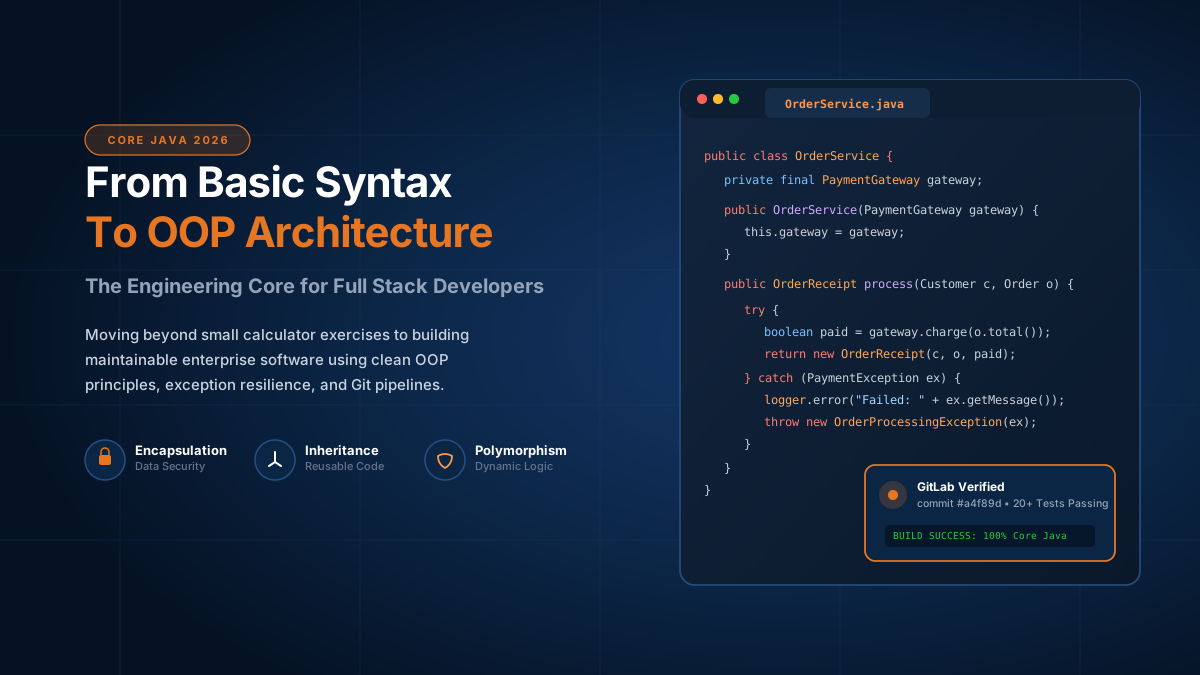
Java is strongly based on object-oriented programming. This means students need to understand how objects and classes can be used to represent different parts of an application.
For example, an online shopping application may have classes such as Customer, Product, Order, and Payment. Each class can contain data and methods related to that part of the application. This makes the code easier to organise and maintain.
The main java object oriented programming concepts include:
Classes and objects: Classes provide a structure, while objects are created from that structure.
Encapsulation: Data and related methods can be grouped together while controlling access to the data.
Inheritance: One class can use properties and methods from another class.
Polymorphism: The same method or interface can behave differently in different situations.
Abstraction: Unnecessary implementation details can be hidden so developers can focus on what an object does.
These concepts are useful when building large applications because they encourage developers to write organised and reusable code.
How Core Java Helps Beginners Move from Coding Exercises to Applications
Beginners often start by writing small programs such as calculating marks, checking whether a number is even or odd, or creating a simple calculator. These exercises are useful because they help students understand programming logic.
The next step is to combine these concepts into a small application. For example, a student learning Java could create a student management program that stores student information, calculates marks, searches for students, and displays results.
This is where coding java becomes more practical. Instead of simply learning syntax, students begin to understand how different classes, methods, collections, and conditions work together.
Regular practice is important during learning java because programming skills improve through writing, testing, correcting, and rewriting code. Students should not focus only on reading examples. They should also create small programs and understand why their code works.
Why Git and Development Tools Should Be Learned Alongside Java
Learning Java alone is not enough for students who want to work as software developers. Modern development also involves tools that help programmers write, manage, test, and maintain code.
Git is one of the most commonly used tools for version control. It allows developers to track changes in their code and work with other developers on the same project. Students who learn Git early can become more comfortable with team based development.
An Integrated Development Environment, or IDE, also makes Java development easier. Tools such as IntelliJ IDEA, Eclipse, and Visual Studio Code can provide features for writing, running, testing, and debugging Java programs.
Students taking a java programming language course should therefore try to practise Java using a proper development environment rather than relying only on basic online editors.
Exception Handling: Turning Basic Java Programs into More Robust Applications
Errors can occur even when a program is correctly written. A user may enter unexpected information, a file may not be available, or a database connection may fail. Java provides exception handling features that allow developers to manage many such situations.
Students learn concepts such as try, catch, finally, throw, and throws. These features help developers handle problems without allowing the entire application to stop unexpectedly.
For example, if a program expects a number but a user enters text, exception handling can help the application respond appropriately. This is an important step from writing basic programs to developing applications that can deal with real user input.
What Does a Beginner Java Developer Need to Learn Beyond Syntax?
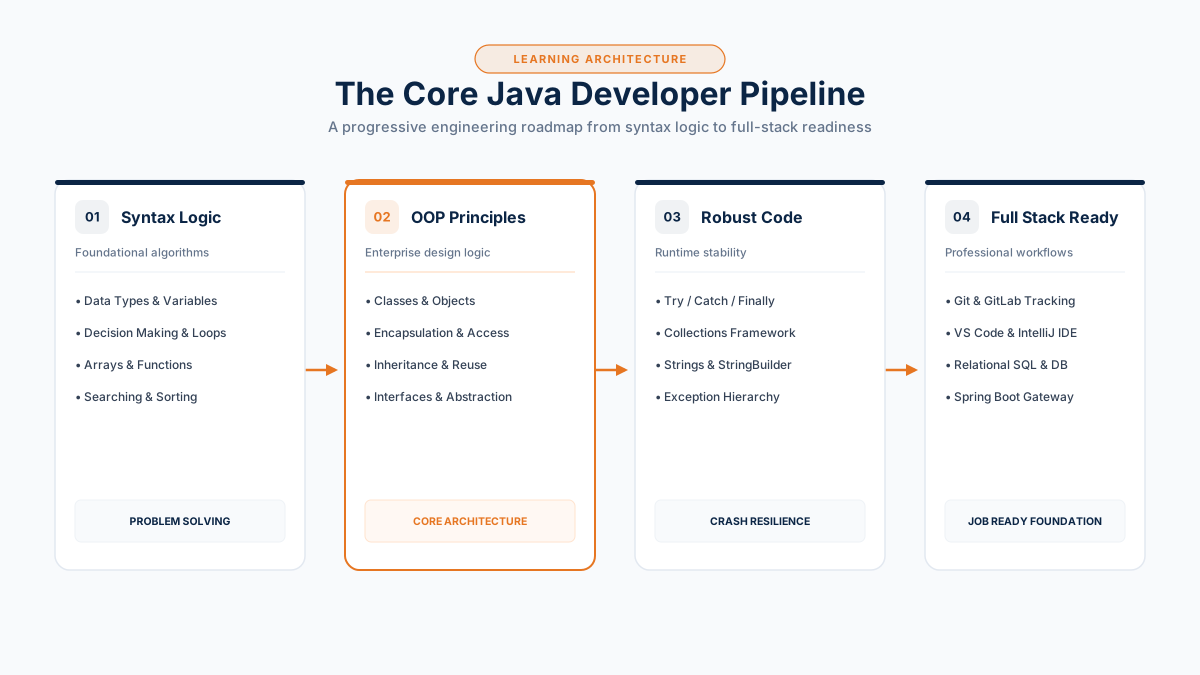
Knowing Java syntax is only one part of becoming a Java developer. Students also need to understand programming logic, problem solving, debugging, data structures, object oriented design, and basic software development practices.
A beginner should gradually develop skills in:
- Java fundamentals and programming logic
- Classes, objects, and object oriented programming concepts
- Collections and commonly used Java APIs
- Exception handling
- Debugging and testing
- Git and version control
- Basic database concepts and SQL
- Data structures and algorithms
- Writing clean and readable code
Once these fundamentals are comfortable, students can move towards technologies used in full stack development, such as Spring, Spring Boot, REST APIs, databases, frontend technologies, and deployment tools.
How to Build a Core Java Learning Path from Scratch
Students can follow a simple learning path instead of trying to study everything at once. A structured java online course can help provide this direction.
Step 1: Start with Java basics: Learn variables, data types, operators, conditions, loops, arrays, and methods.
Step 2: Learn object oriented programming: Practise classes, objects, inheritance, polymorphism, abstraction, and encapsulation.
Step 3: Learn core Java features: Study strings, collections, interfaces, packages, exception handling, and file handling.
Step 4: Practise problem solving: Solve coding problems and create small applications.
Step 5: Learn development tools: Start using an IDE, Git, debugging tools, and basic testing practices.
Step 6: Build projects: Create applications that combine multiple Java concepts.
Step 7: Prepare for full stack development: Move towards databases, backend frameworks, APIs, and frontend technologies.
A structured java online classes format can be useful for students who need regular guidance, practice, and feedback. Those looking for a complete java course should also check whether the program includes practical assignments and projects, rather than focusing only on theory.
Case Study
Consider a college student who has learned basic programming but has never built an application. The student starts with Java variables, loops, methods, and arrays. Initially, the focus is on small coding exercises.
After learning classes and objects, the student creates a simple student management application. The program allows users to add student details, search for students, update information, and display records.
The student then uses collections to manage multiple records and exception handling to manage incorrect input. Git is introduced to track changes to the project.
At this stage, the student has moved from simply learning java to using Java to solve a practical problem. The next step could be learning databases, APIs, Spring Boot, and frontend technologies to develop a more complete application.
What Career Paths Can Core Java Fundamentals Lead To?
Core Java can provide a foundation for several software development paths. Students can use these fundamentals as they move towards roles such as Java developer, backend developer, Java full stack developer, software developer, or application developer.
A Java full stack developer needs more than Core Java. However, strong Java fundamentals can make it easier to understand backend programming, frameworks, APIs, databases, and application architecture.
Students may also choose to take a java full course that gradually connects Core Java with advanced development skills. The important point is to understand the fundamentals before moving into frameworks and advanced tools.
How the NIIT Applied Core Java Program Can Help Beginners Build Practical Skills
Yes. You want the Core Java Applied Program rewritten in exactly this structured style: short introductory paragraphs followed by detailed tables for every major section, rather than long prose.
Why is the Core Java Applied Program by NIIT a useful choice?
The Core Java Applied Program by NIIT is a focused, hands-on program designed to help beginners build practical Java programming skills. It takes learners from setting up a Java development environment to writing structured Java programs and applying object-oriented programming principles.
The program covers Java fundamentals, arrays, strings, functions, searching, sorting, Object-Oriented Programming, exception handling, Git, and GitLab. Learners also complete hands-on assignments and a final programming assessment while building a GitLab portfolio.
Designed for career changers and learners with no coding skills, the program provides a structured pathway to develop Java programming fundamentals and become familiar with professional development practices.
Program at a Glance
| Feature | Details |
|---|---|
| Program Name | Core Java Applied Program |
| Provider | NIIT |
| Duration | 52 hours |
| Course | Building Java Foundations with Engineering Best Practices |
| Core Focus | Core Java, OOP, development environment and version control |
| Learning Approach | Hands-on, assignment-based and mentor-supported |
| Assignments | 20+ hands-on assignments |
| Assessment | Final programming assessment |
| Portfolio | Git-tracked work showcased through GitLab |
| Certification | NIIT Professional Certificate upon successful completion |
| Program Fee | ₹9,999 + 18% GST |
What Does the Core Java Applied Program Cover?
The curriculum focuses on building Java programming fundamentals while introducing learners to tools and practices used in software development.
| Module | Duration | Key Areas |
|---|---|---|
| Building Java Foundations with Engineering Best Practices | 52 hours | Development environment, Git, Java programming, OOP, exception handling and software development fundamentals |
| Total | 52 hours | Core Java foundations with hands-on learning and assessment |
Module: Building Java Foundations with Engineering Best Practices
The module begins with development environment setup and gradually moves into Java programming, version control, and Object-Oriented Programming.
| Learning Area | What Learners Cover |
|---|---|
| Development Environment | IDEs, JDK, VS Code, Node.js and PostgreSQL |
| Version Control | Git, GitLab, SSH keys and README.md files using Markdown |
| Java Programming | Data types, variables, operators, decision making, loops, arrays, functions, searching, sorting, strings and StringBuilder |
| Object-Oriented Programming | Classes, objects, encapsulation, inheritance, polymorphism, abstraction, interfaces and packages |
| Exception Handling | Structured exception handling to manage runtime errors and build robust applications |
| Assessment | Final programming assessment to evaluate Core Java proficiency |
The curriculum moves from basic programming concepts to object-oriented design, giving learners a progressive introduction to Java development.
Tools and Technologies
| Category | Tools and Technologies |
|---|---|
| Java Development | JDK, IntelliJ |
| Code Editor | VS Code |
| Version Control | Git, GitLab |
| Database | PostgreSQL |
| Development Environment | Node.js |
| Documentation | Markdown and README.md |
Tools and Technologies
| Category | Tools and Technologies |
|---|---|
| Java Development | JDK, IntelliJ |
| Code Editor | VS Code |
| Version Control | Git, GitLab |
| Database | PostgreSQL |
| Development Environment | Node.js |
| Documentation | Markdown and README.md |
Learning Outcomes
The program focuses on developing practical Java programming knowledge along with basic software development practices.
| Learning Outcome | Skills Developed |
|---|---|
| Java Environment Setup | Configure a professional Java development environment using the JDK, IDE and other essential tools |
| Version Control | Manage source code using Git and GitLab |
| Java Programming | Write structured Java programs using variables, control flow, loops, arrays and strings |
| Problem Solving | Apply programming concepts such as searching and sorting |
| Object-Oriented Programming | Apply classes, encapsulation, inheritance, polymorphism and abstraction |
| Exception Handling | Handle runtime errors using structured exception handling |
| Portfolio Development | Showcase programming work through GitLab |
| Programming Assessment | Demonstrate Core Java knowledge through a course-end assessment |
Industry-Recognized Certification
Learners who successfully complete the program can earn an NIIT Professional Certificate.
| Certification Feature | Details |
|---|---|
| Certificate | NIIT Professional Certificate |
| Completion Requirement | Successful completion of the Core Java Applied Program |
| Recognition | Positioned as accepted by leading employers and organizations worldwide |
| Easy Sharing | Can be added to LinkedIn, resumes and professional portfolios |
| Career Value | Demonstrates practical skills aligned with industry needs |
Learning Methodology
The program combines structured learning, mentor interaction, practical assignments, and performance tracking.
| Learning Component | Details |
|---|---|
| Structured Learning Roadmap | Clear learning pathways through the LMS with defined milestones and progression |
| Learner Connect Sessions | Live mentor interactions for doubt resolution, concept reinforcement and engagement |
| Hands-on Learning | Practical assignments that allow learners to apply Java concepts |
| Git-Based Practice | Programming work is tracked through Git commits |
| Portfolio Development | Completed work can be showcased through GitLab |
| AI-Assisted Faculty Monitoring | AI-assisted faculty performance analysis supports consistent teaching quality |
| Program Performance Report | Tracks attendance, assignments, assessments, quizzes and overall performance |
Career and Portfolio Development
The program focuses on building foundational Java skills while giving learners practical work that can be showcased through GitLab.
| Portfolio Element | What It Demonstrates |
|---|---|
| Java Assignments | Application of Core Java concepts |
| Programming Exercises | Practice with Java programming and problem solving |
| Git Commits | Understanding of version control and source code tracking |
| GitLab Profile | Ability to showcase programming work |
| Final Assessment | Demonstration of Core Java proficiency |
Who Can Consider This Program?
The program can be relevant for beginners and career changers who want to develop Java programming fundamentals.
| Learning Goal | Relevant Program Component |
|---|---|
| Learn Java programming | Core Java fundamentals |
| Build programming foundations | Variables, operators, loops, arrays and functions |
| Learn Object-Oriented Programming | Classes, objects, inheritance, polymorphism and abstraction |
| Understand error handling | Exception handling |
| Learn version control | Git and GitLab |
| Build a programming portfolio | Git-tracked assignments and GitLab profile |
| Prepare for further Java learning | Strong foundation in Core Java concepts |
Duration, Batch and Fee
| Particular | Details |
|---|---|
| Total Duration | 52 hours |
| Upcoming Batch | 29 September |
| Batch Type | Weekday Batch |
| Schedule | Monday, Tuesday, Thursday and Friday |
| Timing | 7:30 PM to 9:30 PM |
| Custom Schedule | Preferred slot assistance available |
| Program Fee | ₹9,999 |
| GST | 18% GST applicable |
Build Your Skills With NIIT
Core Java gives aspiring developers the foundation they need to understand how Java applications are built. Learning programming logic, java object oriented programming concepts, exception handling, collections, Git, and practical development can help students move from basic coding exercises towards application development.
For students who want structured guidance, NIIT Digital provides career focused technology programs designed to connect learning with practical skills. The Applied Core Java Program can be a starting point for learners who want to strengthen their Java foundation and prepare for the next stages of their software development journey.
Explore the NIIT Digital Applied Core Java Program to understand the learning path and find out how structured training can help you develop practical Java skills.
Ready to Take the Next Step?
Explore the NIIT Digital Applied Core Java Program to understand the learning path and find out how structured training can help you develop practical Java skills.
Explore the ProgramFrequently Asked Questions
1. What is Core Java?
A: Core Java covers the fundamental concepts of Java programming. It includes variables, methods, classes, objects, inheritance, polymorphism, collections, exception handling, and other basic Java features.
2. Why are object oriented programming concepts important in Java?
A: They help developers organise programs using classes and objects. Concepts such as inheritance, encapsulation, abstraction, and polymorphism support reusable and structured application development.
3. Is Core Java enough to become a Java full stack developer?
A: Core Java is an important foundation, but it is not enough by itself. A full stack developer generally needs additional skills in databases, backend frameworks, APIs, frontend technologies, testing, and development tools.
4. Can beginners learn Java through an online course?
A: Yes. Beginners can learn Java through a structured java online course or java online classes. Regular coding practice and project work are important for turning theoretical knowledge into practical skills.
5. What should I learn after Core Java?
A: After building a strong Core Java foundation, students can move towards databases and SQL, data structures and algorithms, Spring and Spring Boot, REST APIs, frontend technologies, Git, testing, and deployment. This can help them progress towards Java backend or full stack development.
NIIT
Expert Contributor
Industry expert contributing to NIIT's knowledge base on technology and education.