


AI ASSISTED CODING FOR JAVA FULL STACK DEVELOPER
AI ASSISTED CODING FOR JAVA FULL STACK DEVELOPER
AI is changing the way developers write, test and improve software. Today, tools for java programming can help developers generate code, explain errors, create test cases and explore possible solutions faster. However, AI works best when it supports strong programming knowledge rather than replacing it. For a full stack java developer, learning how to use AI responsibly can make everyday development more efficient while keeping problem-solving and engineering skills at the centre.
What Is AI Assisted Java Development?
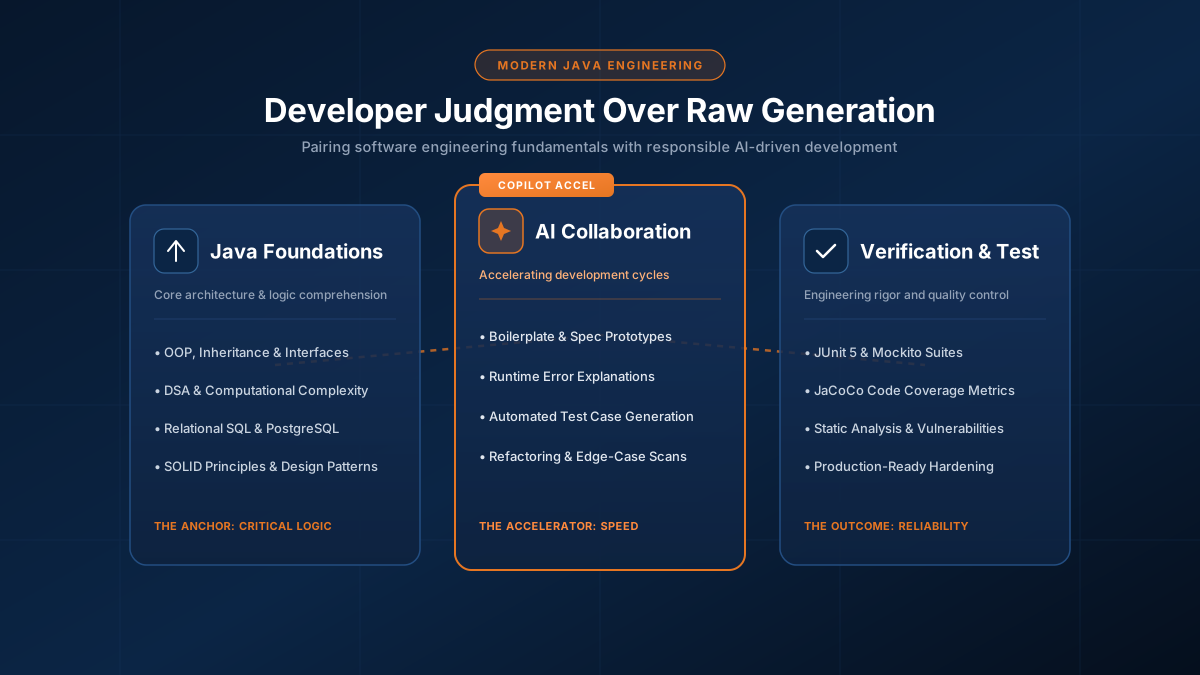
AI assisted Java development means using AI based tools to support different stages of software development. A developer can use a coding assistant to generate a method, explain an unfamiliar Java concept, identify a possible bug or suggest improvements to existing code.
These tools do not remove the need to understand Java. Instead, they can reduce repetitive work and help developers explore solutions more quickly. The developer still needs to decide what the application should do, whether the generated code is correct and how it should fit into the overall system.
AI assisted development can support tasks such as:
- Generating basic Java code
- Explaining compiler and runtime errors
- Creating unit test cases
- Suggesting code improvements
- Converting requirements into an initial implementation
- Finding possible edge cases
- Creating documentation and comments
This makes AI useful across the software development process, but human review remains important.
How AI Coding Assistants Help Java Developers
Modern ai programming tools can help developers move from an idea to a working code sample faster. For example, a developer can describe a requirement for a Java method and ask an AI tool to create an initial version. The developer can then review, modify, test and improve it.
This approach is particularly useful when working on repetitive programming tasks. AI can also explain why a particular solution works, which can help students and junior developers learn while building applications.
For a full stack java developer, AI can assist with several areas:
- Java backend logic
- SQL queries
- API development
- Debugging
- Unit testing
- Documentation
- Refactoring
- Code review
The important point is that the developer remains responsible for the final implementation.
Why Java Fundamentals Still Matter in the Age of AI
The growth of coding with ai does not make Java fundamentals less important. In fact, strong fundamentals become more useful because developers need to check whether AI generated code is actually correct.
A developer who understands variables, loops, classes, inheritance, interfaces, exceptions, collections and algorithms can identify problems that a beginner may miss.
For example, an AI tool may generate code that works for a simple input but fails when the input is empty, unusually large or incorrectly formatted. A developer with strong fundamentals can identify these ai problems and correct the implementation.
Core knowledge remains important in areas such as:
- Object oriented programming
- Data structures and algorithms
- SQL and databases
- Exception handling
- Debugging
- Software design
- Testing
- Version control
AI can accelerate coding, but it does not remove the need for engineering judgment.
The SCVHS Approach to AI Assisted Coding
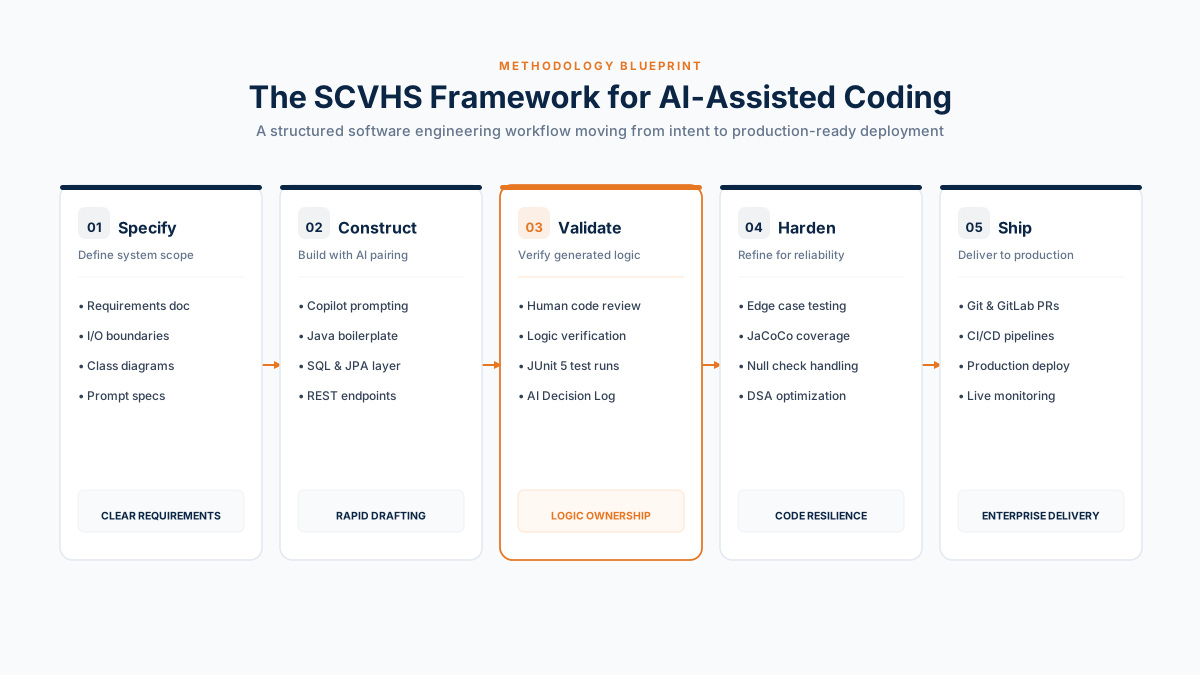
The Specify, Construct, Validate, Harden and Ship approach gives learners a structured way to work with AI instead of simply asking AI to generate code and copying the response.
The process can be understood as follows:
- Specify: Clearly define the requirement and expected behaviour.
- Construct: Use programming skills and AI tools to build the solution.
- Validate: Check whether the solution works as expected.
- Harden: Review, test and improve the code for reliability and quality.
- Ship: Prepare the final solution for use or delivery.
This approach teaches an important lesson: AI should be directed by a developer's requirements and checked through testing and review.
AI Assisted Coding vs Blindly Copying AI Generated Code
There is a major difference between using AI as a development assistant and blindly copying its output. AI generated code may contain incorrect assumptions, inefficient logic, security issues or code that does not match the rest of an application.
A developer should therefore ask:
- Does the code solve the actual requirement?
- Do I understand how the code works?
- What happens with unexpected input?
- Is the solution efficient?
- Does it follow the application's design?
- Has it been tested?
- Can it be maintained later?
This is particularly important for an ai software engineer, where the role involves more than generating code. Developers need to understand requirements, make technical decisions and take responsibility for the software they build.
How AI Can Help with Java Testing and Code Quality
Testing is one area where AI can provide practical support. A developer can ask AI to suggest test cases for a Java method, identify possible edge cases or create an initial JUnit test structure.
However, generated tests also need review. A test is useful only when it checks the behaviour that actually matters.
Java developers can use AI to support:
- Unit test generation
- Test case ideas
- Edge case identification
- Debugging
- Refactoring suggestions
- Code explanations
- Documentation
The NIIT Advanced Java and DSA Applied Program includes JUnit 5, parameterized testing, assertions and JaCoCo code coverage as part of its testing curriculum. Its projects also include Java applications supported by JUnit test suites.
AI, DSA and Problem Solving: What Changes?
AI can suggest solutions to coding problems, but developers still need to understand the problem before accepting an answer. Data structures and algorithms help developers judge whether a solution is suitable.
Consider a search problem involving thousands or millions of records. An AI tool may provide working code, but the developer must understand whether the selected algorithm is efficient enough.
This is why DSA remains an important part of modern software development. Developers should be able to:
- Break complex problems into smaller parts
- Compare different approaches
- Understand time and space complexity
- Select suitable data structures
- Test edge cases
- Improve inefficient solutions
These are also important ai engineer skills because AI assisted development still depends on logical thinking and technical decision making.
Skills of the Modern Java Developer
The modern developer needs a combination of programming knowledge and AI awareness. Completing machine learning and artificial intelligence courses can help learners understand the wider AI ecosystem, but Java developers also need practical software engineering skills.
A modern Java developer should build knowledge in:
- Core and advanced Java
- Object oriented programming
- DSA
- SQL and databases
- Git and version control
- Software design principles
- Testing
- Debugging
- AI assisted development
- Communication and documentation
These skills help developers use AI as part of a wider engineering process rather than treating it as a replacement for programming knowledge.
Case Study
Consider a student developing a Java application connected to PostgreSQL. Instead of asking AI to build the complete application without understanding the requirements, the student first writes the application specification.
The student then uses an AI coding assistant to generate parts of the implementation. Each section is reviewed against the specification, tested and refined before being added to the application.
The workflow could look like this:
Requirement → Specification → AI Assisted Coding → Developer Review → Testing → Refinement → Final Application
This approach creates a better learning experience because the student is not only producing code. The student is learning how to make engineering decisions and explain why those decisions were made.
Can AI Replace Java Developers?
AI can automate parts of programming, but software development involves much more than writing code. Developers need to understand users, business requirements, system behaviour, technical limitations and quality expectations.
AI can produce a possible solution, but developers need to decide whether that solution is appropriate.
For this reason, learning Java remains valuable even as AI coding tools become more common. The role of the developer is increasingly moving towards understanding problems, designing solutions, reviewing AI generated output and ensuring that software works reliably.
The future of Java development is therefore likely to involve greater collaboration between developers and AI tools. Learning tools for java programming can help developers work faster, but strong fundamentals remain the foundation for using those tools effectively.
Why is the Advanced Java and DSA Applied Program by NIIT a strong choice?
The Advanced Java and DSA Applied Program by NIIT is a focused program designed to develop practical Java engineering and problem-solving skills. It takes learners from Java foundations and object-oriented programming to data structures, SQL, advanced Java development, software engineering practices, testing, debugging, and design patterns.
The program combines hands-on coding with engineering practices and AI-assisted development. Learners work on production-oriented projects while following structured development processes.
Program at a Glance
| Feature | Details |
|---|---|
| Program Name | Advanced Java and DSA Applied Program |
| Provider | NIIT |
| Duration | 160 hours |
| Approximate Timeline | 2.5 months |
| Courses | 3 |
| Sprints | 40 |
| Core Focus | Java, DSA, SQL and software engineering |
| Learning Approach | Structured, hands-on and assignment-based |
| Methodology | SCVHS and AI-first methodology |
| Projects | Production-oriented Java projects |
| Certification | Java Certification credential upon successful completion and course-end assessments |
| Program Fee | ₹24,999 + 18% GST |
What Does the Advanced Java and DSA Program Cover?
The curriculum is divided into three modules that progressively build Java programming, problem-solving and software engineering capabilities.
| Module | Duration | Key Areas |
|---|---|---|
| Building Java Foundations with Engineering Best Practices | 52 hours | Java programming, OOP, development environment, Git and software engineering fundamentals |
| Solving Computational Problems Using Data Structures and SQL | 60 hours | Data structures, computational problem-solving and SQL |
| Applying Software Engineering Practices to Develop Advanced Java Applications | 48 hours | Advanced Java, design patterns, testing, debugging, optimization and production-grade development |
| Total | 160 hours | 40 sprints across 3 modules |
Module 1: Building Java Foundations with Engineering Best Practices
The first course establishes the programming and engineering foundation required for Java development.
| Learning Area | What Learners Cover |
|---|---|
| Development Environment | IDE setup, JDK, VS Code, Node.js and PostgreSQL |
| Java Programming | Data types, variables, operators, decision-making, loops, arrays, functions, searching, sorting, strings and StringBuilder |
| Object-Oriented Programming | Classes, objects, encapsulation, inheritance, polymorphism, abstraction, interfaces and packages |
| Exception Handling | Handling exceptions to develop more robust applications |
| Version Control | Git, GitLab, SSH keys and Markdown-based README files |
| Assessment | Course-end assessment covering programming, coding and problem-solving skills |
This stage helps learners build a strong foundation before moving into more advanced problem-solving and application development.
Module 2: Solving Computational Problems Using Data Structures and SQL
The second course focuses on computational problem-solving through data structures and SQL.
| Focus Area | Purpose |
|---|---|
| Data Structures | Develop structured approaches to storing and working with data |
| Problem Solving | Apply computational thinking to coding problems |
| Algorithms | Develop approaches for solving programming problems efficiently |
| SQL | Work with databases and write SQL queries |
| Application of DSA | Connect data structures and problem-solving with practical software development |
The combination of DSA and SQL gives learners two important foundations for working with data and developing software applications.
Module 3: Applying Software Engineering Practices to Develop Advanced Java Applications
The third course moves into advanced application development and engineering practices.
| Focus Area | What Learners Develop |
|---|---|
| Advanced Java | Build applications using advanced Java concepts |
| Design Patterns | Apply established software design approaches |
| SOLID Principles | Develop cleaner and more maintainable software |
| Testing | Create automated tests using JUnit and Mockito |
| Debugging | Identify and resolve application issues |
| Optimization | Improve application performance and code quality |
| Software Engineering | Apply structured development practices to production-oriented applications |
| AI-Assisted Development | Use AI tools while reviewing, validating and owning generated code |
AI-First Software Engineering Approach
An important component of the program is its AI-first methodology. Instead of treating AI as a replacement for programming fundamentals, the program focuses on using AI tools within an engineering workflow.
| Component | How It Is Applied |
|---|---|
| Specification | Define software requirements and engineering specifications |
| AI Assistance | Use AI tools to support coding and development activities |
| Validation | Review and validate AI-assisted outputs |
| Testing | Test code before it moves toward production |
| Hardening | Identify and address potential issues |
| Ownership | Developers remain responsible for the code they deliver |
| AI Decision Log | Document AI-assisted design and implementation decisions |
The program's SCVHS approach emphasizes validating, hardening and taking ownership of code rather than simply accepting AI-generated output.
Tools and Technologies
Learners work with development tools and technologies used across Java application development.
| Category | Tools and Technologies |
|---|---|
| Java Development | JDK, IntelliJ |
| Code Editor | VS Code |
| Version Control | Git, GitLab |
| Database | PostgreSQL |
| Build Management | Maven |
| AI-Assisted Coding | GitHub Copilot |
| Testing | JUnit, Mockito |
| Development Practices | CI pipelines, Agile workflows and AI-assisted engineering |
Projects Learners Build
The program includes practical projects that allow learners to apply Java, database, software engineering and AI-assisted development skills.
| Project | Skills Applied |
|---|---|
| Spec-Driven Java CLI Application Backed by PostgreSQL | Java CLI development, PostgreSQL integration, CRUD operations, JIRA sprint workflows, CI pipelines and AI-assisted software engineering |
| Java Application with Design Patterns and a JUnit Test Suite | Enterprise Java, SOLID principles, design patterns, test-driven development, JUnit, code quality and AI-assisted development |
Learning Outcomes
The program focuses on building both coding knowledge and practical engineering capabilities.
| Learning Outcome | Skills Developed |
|---|---|
| Java Programming | Core Java and object-oriented programming |
| Development Environment | Configure and manage a professional Java development setup |
| Version Control | Use Git for source-code management |
| AI-Assisted Engineering | Direct, validate and review AI-assisted development workflows |
| DSA | Solve computational problems using data structures |
| SQL | Write efficient SQL queries |
| Software Design | Apply design patterns and engineering principles |
| Testing | Develop reliable applications using testing frameworks |
| Debugging | Identify and resolve coding issues |
| Optimization | Improve code quality and application performance |
| Technical Communication | Present engineering decisions through architecture walkthroughs and live demonstrations |
| Portfolio Development | Build practical projects that demonstrate Java engineering skills |
Certification
Successful completion of the program and course-end assessments leads to the Java Certification credential.
| Certification Feature | Details |
|---|---|
| Credential | Java Certification |
| Completion Requirement | Successful program completion and course-end assessments |
| Professional Use | Can be added to resumes and professional profiles |
| Portfolio Support | Can be presented alongside practical Java projects |
| Skill Focus | Java programming and engineering proficiency |
Learning Methodology
The program combines structured learning, practical assignments, mentorship and performance tracking.
| Learning Component | Details |
|---|---|
| Structured Roadmap | Defined learning milestones and module progression |
| Mentorship | Live learner-connect sessions with mentors |
| Hands-on Practice | Coding assignments and practical projects |
| AI-First Methodology | AI tools integrated into software engineering workflows |
| High-Intensity Learning | Focused learning through structured sprints |
| DSA Preparation | Practice and mock problem-solving activities |
| Performance Tracking | Attendance, assignments, assessments, quizzes and overall progress |
| Faculty Quality Monitoring | AI-assisted analysis of faculty performance and delivery |
Career and Portfolio Development
The program is structured around practical software engineering rather than only theoretical Java concepts. Learners finish with project work that can be used to demonstrate their technical capabilities.
| Portfolio Element | What It Demonstrates |
|---|---|
| Java CLI Application | Java programming and database integration |
| PostgreSQL Integration | Database and CRUD skills |
| Design Patterns Project | Software design and maintainability |
| JUnit Test Suite | Testing and code quality |
| AI Decision Log | Responsible AI-assisted development |
| CI Workflow | Software engineering and development practices |
| Architecture Walkthrough | Ability to explain technical decisions |
The program also encourages learners to showcase professional project work on platforms such as LinkedIn and in their technical portfolios.
Who Can Consider This Program?
The program can be relevant for learners who want to build or strengthen their skills in Java programming, data structures, SQL and software engineering.
| Learning Goal | Relevant Program Component |
|---|---|
| Learn Java programming | Core Java and OOP |
| Strengthen programming fundamentals | Java foundations and engineering practices |
| Prepare for DSA-based problem solving | Data structures and computational problem solving |
| Learn SQL | SQL and database development |
| Build production-oriented applications | Advanced Java and software engineering |
| Learn design patterns | SOLID principles and GoF design patterns |
| Improve testing skills | JUnit and Mockito |
| Explore AI-assisted coding | GitHub Copilot and AI-first development |
| Build a technical portfolio | Production-oriented Java projects |
Duration, Batch and Fee
| Particular | Details |
|---|---|
| Total Duration | 160 hours |
| Approximate Timeline | 2.5 months |
| Upcoming Batch | 29 September |
| Schedule | Monday, Tuesday, Thursday and Friday |
| Timing | 7:30 PM to 9:30 PM |
| Program Fee | ₹24,999 |
| GST | 18% GST applicable |
Build Your Java Skills with NIIT Digital
AI is changing how developers write software, but strong programming fundamentals remain essential. Learning Java, DSA, SQL, testing and software design gives developers the knowledge needed to review and improve AI generated code.
NIIT Digital's Advanced Java and DSA Applied Program combines these fundamentals with AI assisted development practices, including GitHub Copilot and the SCVHS pipeline. For students and aspiring developers who want to understand both Java engineering and modern course ai practices, the program provides a structured, hands-on learning path.
Ready to build practical Java development skills for an AI assisted software world?
Explore the Advanced Java and DSA Applied Program by NIIT Digital and start building your foundation in Java, DSA, SQL and modern software engineering.
Explore the ProgramFrequently Asked Questions
1. What is AI assisted coding in Java?
AI assisted coding in Java means using AI tools to support programming tasks such as code generation, debugging, testing, documentation and code improvement. The developer remains responsible for reviewing, testing and approving the final code.
2. Are AI coding tools useful for Java developers?
Yes. AI coding tools can help Java developers generate repetitive code, understand errors, create test cases and explore possible solutions. Their value depends on how well developers understand and review the generated code.
3. Do I still need to learn Java fundamentals if I use AI?
Yes. Java fundamentals are important because developers need to understand, test and improve AI generated code. Knowledge of OOP, DSA, SQL, debugging and testing helps developers identify incorrect or inefficient solutions.
4. What is the SCVHS approach to AI assisted coding?
SCVHS stands for Specify, Construct, Validate, Harden and Ship. It provides a structured process where developers define requirements, construct a solution, validate it, improve its quality and prepare it for delivery. NIIT uses this approach in its Advanced Java and DSA Applied Program.
5. What does the NIIT Advanced Java and DSA Applied Program cover?
The program covers Java programming, OOP, DSA, SQL, PostgreSQL, Git, modern Java, SOLID principles, design patterns, testing and AI assisted software engineering. It is a 160 hour program delivered through 40 sprints and includes practical projects.
NIIT
Expert Contributor
Industry expert contributing to NIIT's knowledge base on technology and education.